
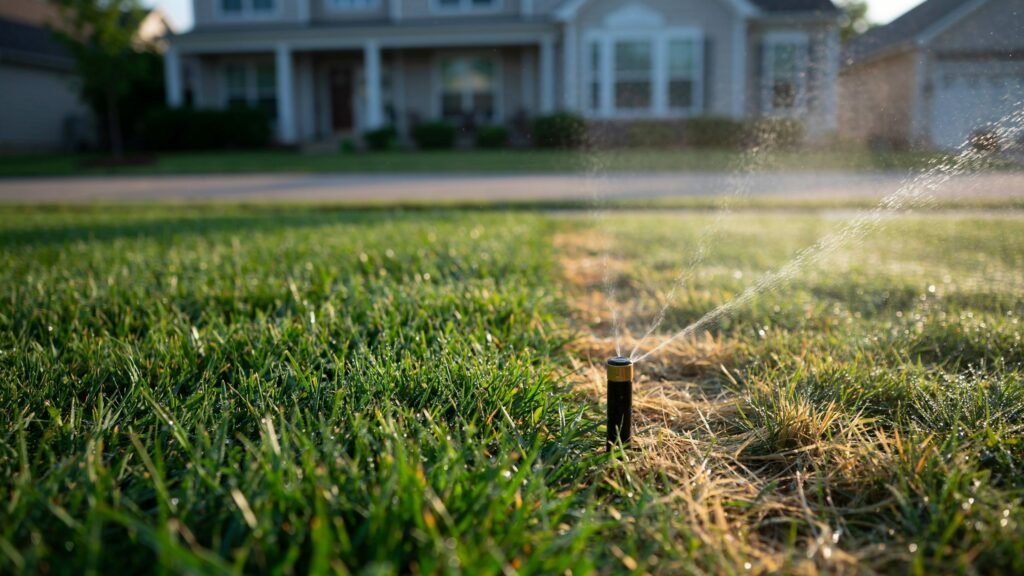
A lawn that turns yellow after watering usually has one of six causes: too much water, too little water, uneven sprinkler coverage, compacted soil, a nutrient shortage, or a fungal disease that spreads on wet blades. Check them in order: how much water the lawn really gets, when you water, how evenly the sprinklers cover it, what the soil needs, and whether disease or grubs are involved.
This guide covers home lawns watered by an in-ground sprinkler system, a hose-end sprinkler, or a timer. It does not cover golf-course turf, newly seeded lawns, or lawns damaged by herbicide spills. Follow the steps in order, because each one rules out a different cause.
Table of Contents
Why Is My Lawn Turning Yellow After Watering?
Watering rarely creates a yellow lawn from nothing. More often it exposes a problem that was already there. Saturated soil suffocates roots, shallow watering leaves them dry, blocked or tilted sprinklers skip patches, and wet blades give fungus a place to grow. The fastest fix is to match the pattern of yellowing to a cause, confirm it with a few cheap tests, and then adjust your watering.
Here is the short version:
- Rule out look-alikes such as pet urine and fertilizer burn.
- Check how much water the lawn actually receives with a catch-can test.
- Check when and how often you water.
- Look for uneven coverage and water running off.
- Test the soil, and the water if you use a well.
- Inspect the blades and roots for disease and grubs.
Before You Start: Rule Out These Look-Alikes
Some yellow patches only seem to appear “after watering” because the water made them visible. Rule these out first so you do not fix the wrong problem:
- Pet urine: yellow spots, often with a darker green ring around the edge.
- Fertilizer burn: yellow or brown stripes that follow the path of a spreader, usually after an uneven or heavy application.
- Iron staining from well water: rust-colored marks on sidewalks, siding, and sometimes grass blades. This is surface staining, not stress, and it needs a different fix.
The 3-Part Rule: Water, Soil, Living Threats
Think of a yellow lawn as one of three problems: water (how much, when, and how evenly), soil (nutrients, pH, and compaction), or living threats (disease and grubs). Your job is to eliminate one at a time until only the real cause is left.
You only need a few things:
- A long screwdriver
- Four to six shallow, straight-sided containers (tuna cans work well)
- A ruler
- A trowel or shovel
- A soil test kit or a soil test from your local extension office
Symptom Finder: What Does Your Lawn Look Like?
Find your symptom, then jump to the matching step.
Yellow circles or strips that follow your sprinkler layout. This points to uneven coverage. Go to Step 3.
The whole lawn is a pale, even yellow. Suspect soil nutrients or saturated roots. Go to Step 1, then Step 4.
The lawn feels spongy and the soil stays wet. This is the classic overwatering pattern. Go to Steps 1 and 2.
Yellow, dry, and crunchy, with hard soil. Water is either too little or running off. Go to Steps 1 and 3.
Spots with rings, or tan lesions on the blades. This points to fungal disease. Go to Step 5.
Yellow turf that lifts like a rug. Roots are gone, from grubs or rot. Go to Step 5.
Yellowing started after you switched to evening watering. Go to Step 2.
Step 1: Measure How Much Water the Lawn Really Gets
Start with the amount, because guessing is the most common mistake.
- Place the containers at different spots across one watering zone.
- Run the zone for 15 minutes.
- Measure the depth of water in each container with a ruler.
- Compare the results. Large differences mean uneven coverage. Very small amounts everywhere mean the lawn is getting less water than you think.
- The next day, push a long screwdriver into the soil. If it slides in easily, moisture is probably reaching the roots. If it stops after an inch or two, watering is shallow or the soil is compacted.
Many extension services commonly cite roughly 1 inch of water per week for lawns, rainfall included. Your grass type, soil, and climate change that number, so confirm it with your local extension office.
Step 2: Check When and How Often You Water
Timing can turn a healthy lawn yellow even when the total amount is right.
- Too frequent: Watering a little every day keeps the top layer wet and the roots shallow. Water less often and for longer instead.
- Too much: Saturated soil pushes air out of the soil, and roots cannot breathe. Signs include soil that is soggy a day after watering, mushrooms, algae, and yellowing in low or shaded spots.
- Too little: Heat and drought stress push grass toward dormancy, which looks yellow or straw-colored.
- At night: Blades that stay wet for hours overnight give fungal disease a better chance to spread. Early morning is widely recommended because the grass dries as the sun rises and less water evaporates.
An overwatered lawn can look just like a thirsty one, so check the soil before you add more water.
Step 3: Check Sprinkler Coverage and Runoff
A system that runs for the right amount of time can still leave dry spots.
- Run each zone and watch the spray.
- Look for clogged or damaged nozzles, tilted or sunken heads, and heads blocked by grass or mulch.
- Check whether the water reaches the corners and edges.
- Watch for runoff. If water flows onto the pavement within a few minutes, the soil is not absorbing it fast enough.
For runoff, try cycle and soak: split the run time into two or three shorter cycles with a pause between them so the soil can absorb each round. Many controllers support this feature. See our guides to the best automatic sprinkler timers and the best water sprinkler timers for which features to look for.
If heads need adjusting, follow our step-by-step guide on how to adjust Rain Bird sprinkler heads. If they are worn out or poorly matched to a small yard, our roundup of the best sprinkler heads for small lawns can help. If a zone will not start at all, see our guide to sprinkler system electrical troubleshooting.
Step 4: Test the Soil and the Water
If watering looks right, the soil may be the problem.
- Nitrogen shortage: The whole lawn fades to a pale yellow-green, usually starting with older blades. Heavy watering or rain can move nitrogen out of the root zone, especially in sandy soil.
- High soil pH: The soil may contain iron, but the grass cannot absorb it, so new growth turns yellow.
- Compaction and thatch: Both keep water on the surface so it never reaches the roots.
A soil test shows pH, nutrient levels, and what to apply. Many state university extension services offer testing or can point you to a lab, and it usually costs far less than buying products that do not fit the problem. The USDA keeps a directory of land-grant university extension websites where you can find your state’s guidance.
Using well or reclaimed water? Some sources contain enough dissolved salts or minerals to stress grass over time, especially in dry regions where rainfall does not flush the soil. Ask your extension office or a certified water testing lab how to test it.
Step 5: Look for Disease and Grubs
Check the blades and roots last.
Fungal disease: Diseases such as brown patch and dollar spot favor warm, humid conditions and long periods of leaf wetness. Look at blades in the early morning for lesions, banding, or fuzzy growth. Many diseases look alike, so an extension office or licensed lawn professional can identify which one you have.
Grubs: White grubs feed on grass roots. To check:
- Grab a handful of the yellow turf and tug.
- If it lifts easily with few roots attached, cut and peel back a square foot of sod.
- Look for C-shaped, cream-colored grubs in the top few inches of soil.
Extension services publish treatment thresholds for your area, so check before applying any product.
Yellow Lawn Cheat Sheet
| What you find | What it means | What to do |
|---|---|---|
| Screwdriver slides in easily, soil is soggy | Overwatering | Water less often, skip cycles after rain |
| Screwdriver stops after 1-2 inches | Shallow watering or compaction | Water deeper, use cycle and soak, consider aeration |
| Big differences between catch cans | Uneven coverage | Clean nozzles, straighten heads, replace worn parts |
| Water runs onto pavement | Soil not absorbing | Cycle and soak, check for compaction and thatch |
| Even pale yellow, slow growth | Nutrient shortage or pH problem | Soil test, then follow lab results |
| Spots with lesions or rings | Fungal disease | Water in early morning, get a diagnosis |
| Turf lifts with few roots, grubs present | Grub damage | Check local thresholds before treating |
| Yellow stripes after fertilizing | Fertilizer burn | Water in lightly, avoid reapplying |
These are typical patterns, not guaranteed diagnoses. Grass type, season, soil, and local climate all change what you see, so confirm important decisions with your local extension office.
Is It Watering or Something Else?
Sometimes the answer is that watering is fine. If the catch-can test shows even coverage, the soil is moist at the right depth, you water in the morning, and the yellowing still spreads, look at soil nutrients, disease, or grubs. Trust your tests: if the water checks all pass, stop adjusting the schedule and move on to the next cause.
How to Stop It From Happening Again
Once you have fixed the cause, these settings help prevent a repeat:
- Schedule watering for early morning.
- Use separate zones and run times for sun, shade, and slopes, since they dry at different rates.
- Use cycle and soak on clay or sloped areas.
- Add a rain sensor or a weather-based controller so the system skips cycles when it is not needed.
- Check heads and nozzles every spring.
If you decide to replace your controller, our guide to the best programmable sprinkler timers compares options by zones, mounting, and ease of setup. The EPA’s WaterSense program certifies weather-based irrigation controllers that adjust schedules using weather data. Check current labeled models and their specifications before you buy.
When to Call a Professional
Call a lawn care or irrigation professional if:
- The yellowing spreads fast.
- You have run through all five steps and still cannot find the cause.
- Drainage problems seem built into the yard.
- The system shows signs of broken pipes or valves, such as constant soggy areas or a sudden drop in pressure.
- You need a disease or grub diagnosis you cannot confirm yourself.
The Irrigation Association is a good place to look for qualified irrigation professionals.
Frequently Asked Questions
Can too much water turn grass yellow?
Yes. Saturated soil limits oxygen and weakens roots, which leads to yellowing and can make fungal disease more likely.
Will yellow grass turn green again?
Often, yes, if the cause is corrected and the roots are still alive. Grass killed by grubs or severe rot may need overseeding or patching.
Should I fertilize yellow grass right away?
Not before you know the cause. Fertilizer will not fix overwatering, grubs, or poor drainage, and extra nitrogen can stress some lawns. A soil test shows what is actually needed.
Why is my lawn yellow only in some spots?
Look for uneven sprinkler coverage, compacted soil, pet urine, shade and drainage differences, or localized pests and disease.
What is the best time of day to water to avoid yellow grass?
Early morning is widely recommended. The grass dries as the sun rises, and less water is lost to evaporation than at midday.
Why does my lawn turn yellow after rain or watering in summer?
Warm, humid conditions with long leaf wetness favor fungal disease, and saturated soil can suffocate roots. Check blades for lesions and the soil for sogginess.
How long until I see improvement?
It depends on the grass type, season, and cause. Grass often responds within a couple of weeks once the cause is corrected, but slow-growing or dormant lawns can take longer.
What to Read Next
Once your lawn recovers, you may want to upgrade how it gets watered. Browse our best programmable sprinkler timers, the best digital sprinkler timers, and the best water sprinkler timers.