

Introduction
When it comes to watering crops, gardens, or lawns efficiently, understanding sprinkler irrigation vs drip irrigation is essential. Both systems are widely used in agriculture and landscaping, but they differ in water delivery, efficiency, and suitability for different crops and terrains.
What Is Sprinkler Irrigation?
Sprinkler irrigation is a modern method of watering crops, gardens, lawns, or sports fields by distributing water through a network of pipes and sprinkler heads. The system sprays water in small droplets, mimicking natural rainfall, to ensure even coverage across the area.
This method of irrigation is widely used in agriculture and landscaping because it provides controlled and uniform watering, which is one of the main reasons it is often compared with drip irrigation. Understanding sprinkler irrigation vs drip irrigation helps farmers and gardeners choose the right system for their needs.
Sprinkler irrigation systems are widely used for lawns, orchards, and vegetable fields. Learn more about how to install a sprinkler irrigation system on your farm or garden
How Sprinkler Irrigation Works
A sprinkler irrigation system typically consists of the following components:
- Water Source: A borewell, canal, reservoir, or water tank supplies water.
- Pump: Creates the pressure needed to move water through pipes.
- Main & Sub-main Pipes: Distribute water to different parts of the field.
- Sprinkler Heads: Spray water evenly over crops or plants, simulating rainfall.
Water is pumped from the source through the network of pipes and released via sprinkler heads. This controlled distribution helps prevent overwatering, reduces water waste, and ensures that plants receive adequate moisture for optimal growth.
Benefits of Sprinkler Irrigation
- Provides uniform water distribution, unlike traditional flood irrigation.
- Reduces water wastage and prevents soil erosion.
- Can be used on uneven land, slopes, or irregular fields.
- Saves time and labour, as many systems can operate automatically.
What Is Drip Irrigation?
Drip irrigation is a highly efficient watering method that delivers water directly to the root zone of plants through a network of tubes, pipes, and small emitters. Unlike sprinkler systems, which spray water over the entire area, drip irrigation targets only the plants, reducing water waste and evaporation.
Understanding sprinkler irrigation vs drip irrigation is essential for farmers, gardeners, and landscapers because it helps determine the best irrigation system for specific crops, land types, and water availability.
How Drip Irrigation Works
A typical drip irrigation system includes the following components:
- Water Source: A borewell, tank, canal, or reservoir supplies water to the system.
- Pump and Pressure Regulator: Ensures consistent flow and prevents damage to emitters.
- Main and Lateral Pipes: Distribute water throughout the field to reach each plant.
- Emitters or Drippers: Release water slowly and directly to the soil at the base of each plant.
Water flows slowly through the pipes and exits at the emitters, providing precise hydration to plant roots. This method helps maintain optimal soil moisture, reduces weed growth, and prevents overwatering.
Benefits of Drip Irrigation
- Water Efficiency: Uses significantly less water than traditional irrigation and sprinklers.
- Improved Crop Growth: Delivers water directly to roots, promoting healthier plants.
- Reduces Weed Growth: Water is applied only where needed, limiting water for weeds.
- Suitable for Row Crops and Orchards: Ideal for vegetables, fruits, and other high-value crops.
Sprinkler Irrigation vs Drip Irrigation – Key Differences
When deciding on the right irrigation system, understanding the key differences between sprinkler irrigation vs drip irrigation is crucial. Both methods have unique advantages and are suited for different types of crops, land, and water availability.
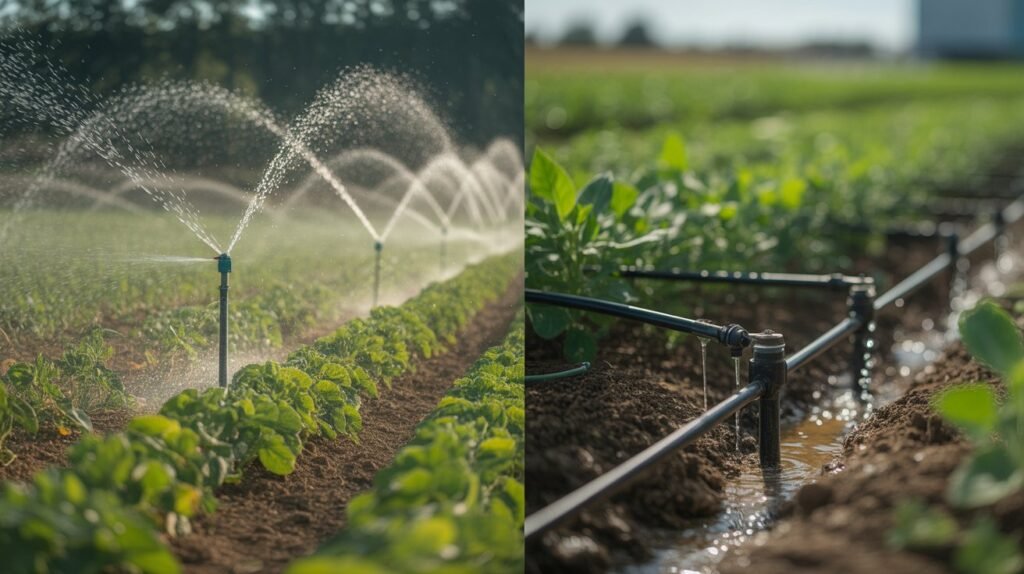
1. Water Distribution
- Sprinkler Irrigation: Sprays water over the entire area, similar to rainfall. Ideal for lawns, pastures, and large fields.
- Drip Irrigation: Delivers water directly to the plant roots, minimising wastage. Best for row crops, orchards, and high-value plants.
Takeaway: A sprinkler covers a wide area, while a drip targets precise locations.
2. Water Efficiency
- Sprinkler Irrigation: Moderate water savings; some water can evaporate or run off.
- Drip Irrigation: Highly efficient, reducing water loss by up to 50% compared to sprinklers.
Takeaway: For limited water supply, drip irrigation is usually more suitable.
3. Installation and Maintenance
- Sprinkler Irrigation: Easier to install on large and uneven fields; maintenance mainly involves cleaning sprinkler heads and checking pumps.
- Drip Irrigation: Requires careful planning and more intensive maintenance; emitters can clog if water is not filtered properly.
Takeaway: Sprinklers are simpler for large-scale use, while drip systems need more attention.
4. Land Suitability
- Sprinkler Irrigation: Works well on slopes and uneven land.
- Drip Irrigation: Best suited for flat or gently sloped fields to ensure uniform flow.
Takeaway: Sprinklers are versatile for varied terrain, while drip requires controlled slope and setup.
5. Crop Types
- Sprinkler Irrigation: Suitable for a wide variety of crops, including cereals, pastures, lawns, and vegetables.
- Drip Irrigation: Ideal for high-value crops like vegetables, fruits, and orchards.
Takeaway: Drip irrigation is more crop-specific, while sprinklers are versatile.
6. Cost Comparison
- Sprinkler Irrigation: Moderate initial cost; lower maintenance for large areas.
- Drip Irrigation: Higher setup cost; maintenance includes cleaning filters and replacing emitters.
Takeaway: Sprinklers are often cost-effective for large-scale irrigation, whereas drip irrigation pays off with water savings and high-value crop efficiency.
Pros and Cons of Sprinkler Irrigation
Understanding the pros and cons of sprinkler irrigation is essential when comparing sprinkler irrigation vs drip irrigation. This helps farmers, landscapers, and gardeners decide which system suits their land, crops, and water availability best.
Pros of Sprinkler Irrigation
- Uniform Water Distribution
Sprinkler irrigation sprays water evenly over fields or lawns, ensuring all plants receive sufficient moisture. - Works on Uneven Land
Unlike flood irrigation, sprinklers can operate effectively on sloped or irregular terrain. - Time and Labour Saving
Automated systems reduce the need for manual watering, saving time and reducing labour costs. - Versatility
Suitable for a wide range of crops, including cereals, vegetables, pastures, lawns, and gardens. - Prevents Soil Erosion
Gentle spraying minimises water runoff and protects the topsoil, promoting healthy plant growth.
Cons of Sprinkler Irrigation
- Water Loss Due to Evaporation or Wind
Sprayed water can evaporate quickly or be blown away by strong winds, reducing efficiency. - Higher Initial Cost
Installing a sprinkler system can be more expensive than traditional irrigation methods. - Maintenance Requirements
Sprinkler heads, pipes, and pumps need regular inspection and cleaning to prevent clogging. - Not Ideal for All Crops
Some high-value or water-sensitive crops may benefit more from targeted watering methods like drip irrigation.
Pros and Cons of Drip Irrigation
When comparing sprinkler irrigation vs drip irrigation, it is important to understand the pros and cons of drip irrigation. Drip irrigation is a precise method that delivers water directly to plant roots, making it highly efficient, but it also has certain limitations.
Pros of Drip Irrigation
- High Water Efficiency
Drip irrigation delivers water directly to the roots, minimising evaporation and runoff. It can save up to 50% of water compared to traditional and sprinkler systems. - Improved Crop Growth
Plants receive consistent moisture at the root zone, which promotes healthier growth and higher yields. - Reduced Weed Growth
Since water is applied only where plants grow, weed growth is minimised, reducing competition for nutrients. - Fertiliser Efficiency
Fertilisers can be delivered directly through the drip lines, improving nutrient uptake and reducing waste. - Suitable for High-Value Crops
Ideal for vegetables, fruits, orchards, and row crops where precise watering is essential.
Cons of Drip Irrigation
- Higher Installation Cost
Setting up a drip system can be expensive due to pipes, emitters, and filtration requirements. - Maintenance Intensive
Emitters can clog from sediment or algae, requiring regular cleaning and monitoring. - Limited Coverage
Drip irrigation is not ideal for large open fields or lawns where wide coverage is needed. - Sensitive to Water Quality
Poor water quality can damage pipes and clog emitters, reducing system efficiency.
Which System Is Better for Your Needs?
Choosing between sprinkler irrigation vs drip irrigation depends on several factors, including crop type, land size, terrain, water availability, and budget. Both systems offer unique advantages, and understanding these can help you make the best decision for your farm, garden, or lawn.
1. Crop Type and Planting Pattern
- Sprinkler Irrigation: Works well for a wide variety of crops, including cereals, pastures, and large lawns. It is especially effective for areas where plants are evenly spaced or spread across a large area.
- Drip Irrigation: Best suited for row crops, orchards, vegetables, and high-value plants that require precise watering at the root zone.
Recommendation: Use drip irrigation for sensitive or high-value crops and sprinklers for general crops or large lawns.
2. Land Size and Terrain
- Sprinkler Irrigation: Ideal for large and uneven areas. Sprinklers can operate efficiently on slopes and irregular land.
- Drip Irrigation: Works best on flat or gently sloped land to ensure uniform water distribution.
Recommendation: For uneven or hilly terrain, sprinklers may be more practical.
3. Water Availability
- Sprinkler Irrigation: Uses more water than drip systems and can experience some loss due to wind or evaporation.
- Drip Irrigation: Highly water-efficient, delivering water directly to plant roots and reducing waste.
Recommendation: If water is limited, drip irrigation is usually the better choice.
4. Budget and Maintenance
- Sprinkler Irrigation: Moderate initial cost; easier maintenance compared to drip systems.
- Drip Irrigation: Higher setup cost and requires regular maintenance to prevent emitter clogging.
Recommendation: Sprinklers are more cost-effective for large areas with lower-value crops, while drip irrigation is an investment that pays off for high-value crops or water-scarce regions.
5. Overall Recommendation
- Choose sprinkler irrigation if you need to cover large, uneven areas with multiple crop types and want a simpler, low-maintenance system.
- Choose drip irrigation if you want maximum water efficiency and precise watering and are cultivating high-value crops or areas with a limited water supply.
By carefully evaluating your land, crops, and resources, you can decide which system delivers the most benefits. Comparing sprinkler irrigation vs drip irrigation ensures that your investment in irrigation will result in healthy crops, efficient water use, and long-term savings.
Conclusion
Choosing the right irrigation system is essential for maximising crop growth, conserving water, and reducing labour costs. When evaluating sprinkler irrigation vs drip irrigation, it’s clear that each method has unique advantages depending on your land, crops, and available resources.
Sprinkler irrigation is perfect for large areas, uneven terrain, and a variety of crops. It provides uniform water coverage, reduces the need for manual watering, and is relatively easy to maintain over time. Its versatility makes it a great choice for farms, lawns, and gardens that require broad coverage.
Drip irrigation, on the other hand, excels in precision and water efficiency. By delivering water directly to plant roots, it minimises waste, supports high-value crops, and ensures optimal growth even in areas with limited water supply. While it requires careful setup and regular maintenance, the benefits in water conservation and yield often outweigh the initial investment.
FAQs
1. What is the main difference between sprinkler irrigation and drip irrigation?
Sprinkler irrigation sprays water over the entire area like rainfall, while drip irrigation delivers water directly to the plant roots through emitters. The choice depends on crop type, land size, and water availability.
2. Which system saves more water: sprinkler or drip irrigation?
Drip irrigation is more water-efficient, as it reduces evaporation and runoff by delivering water precisely to plant roots. Sprinklers are moderately efficient but may lose some water to wind or evaporation.
3. Which system is better for uneven land?
Sprinkler irrigation works well on uneven or sloped land because the water is sprayed across the field. Drip irrigation is best for flat or gently sloped areas to maintain uniform water distribution.
4. Which system is cheaper to install?
Sprinkler irrigation generally has a lower initial cost and simpler setup. Drip irrigation requires a higher upfront investment and careful installation of pipes and emitters.
5. Are both systems suitable for all crop types?
- Sprinkler irrigation: Suitable for cereals, pastures, lawns, and many types of vegetables.
- Drip irrigation: Ideal for high-value crops, row crops, orchards, and plants that need precise watering.
6. How does maintenance compare between the two systems?
- Sprinkler irrigation: Requires occasional cleaning of sprinkler heads and checking pumps.
- Drip irrigation: Requires regular cleaning of filters and monitoring of emitters to prevent clogging.
7. Which system is better for long-term investment?
Both systems have long-term benefits depending on the situation. Sprinklers are cost-effective for large areas and general crops, while drip irrigation pays off for water efficiency and high-value crops.
8. Can both systems improve crop yield?
Yes. Sprinkler irrigation ensures uniform water distribution, which supports healthy growth. Drip irrigation delivers precise watering and nutrients directly to roots, often resulting in higher yields for sensitive crops.
Maintaining a sprinkler system is essential for a healthy lawn. For tips on keeping your home and garden clean, visit Vacuum and Mop for expert advice.