
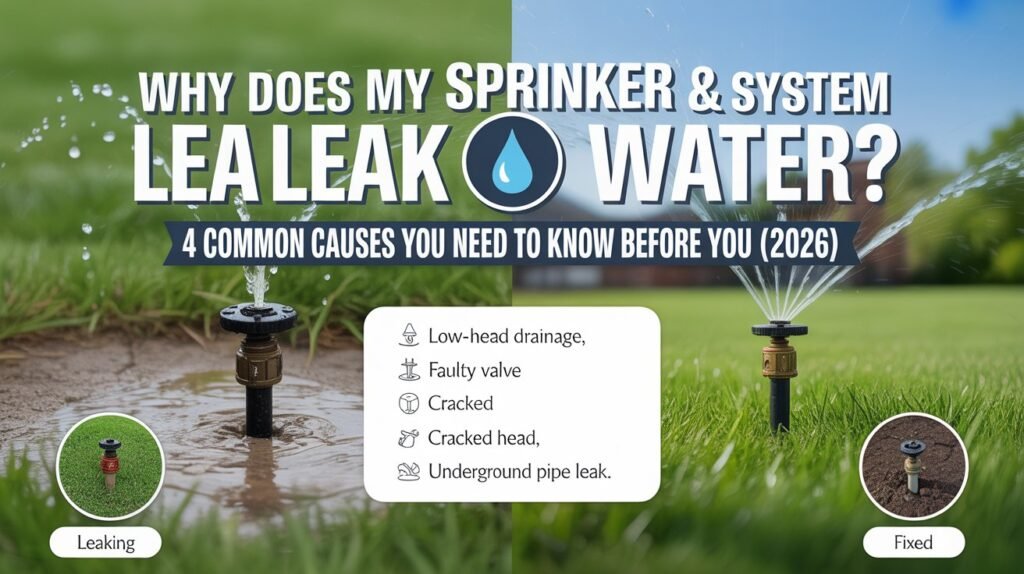
Why Does My Sprinkler System Leak Water?
You walk outside and there’s a wet patch that wasn’t there yesterday, or a sprinkler head still dripping ten minutes after the cycle ended. Nine times out of ten, the cause is one of four things, and you can usually tell which one just by watching where and when the water shows up.
Quick Answer: Sprinkler leaks come from four main sources: low-head drainage (water draining out of the lowest head after shutoff), a valve that isn’t sealing fully, a cracked or damaged sprinkler head, or a broken underground pipe. Low-head drainage and valve leaks are the most common, and both are usually fixable without digging up your yard.
Table of Contents
What You Need to Know
- Low-head drainage — water trickling from the lowest head on a zone after it shuts off — causes most “phantom” leaks and isn’t actually a broken system.
- A leaking valve lets water through even when the system is fully off; you can confirm this with a simple water meter test in under 5 minutes.
- Cracked heads only leak while that specific zone is running, and they’re the easiest fix.
- Underground pipe leaks show up as unexplained wet patches, low pressure, or a rising water bill, and usually need a professional.
- According to the EPA WaterSense program, household leaks waste an estimated 900 billion gallons of water nationwide every year — so a small drip is worth fixing, not ignoring.
Why Is My Sprinkler System Leaking?
Bold claim: most sprinkler leaks trace back to gravity, not a broken part. When a zone shuts off, any water still sitting in the pipes has to go somewhere, and it exits through the lowest sprinkler head on that line. That’s low-head drainage, and it’s the single most common reason homeowners think their system is broken when it’s actually working exactly as designed.
The other three causes are: a valve that isn’t closing all the way, a sprinkler head that’s cracked or knocked loose, and a pipe that’s cracked or corroded underground. Each one has a different timing pattern, and that timing is the fastest way to tell them apart.
Leak Cause vs. Symptom Reference Table
| Symptom | Most Likely Cause | DIY Fix Difficulty |
|---|---|---|
| Drips only for a few minutes after the zone shuts off | Low-head drainage | Easy |
| Water keeps running even with the controller fully off | Valve not sealing | Medium |
| Wet spot appears only when one specific zone runs | Cracked head or lateral line | Medium |
| Valve box stays full of water between cycles | Debris in valve or cracked valve body | Medium |
| Wet patch shows up regardless of zone, water bill climbs | Underground main line leak | Hard — call a pro |
Save or screenshot this reference table — it covers the four most common leak patterns and points you straight to the right section below.
Low-Head Drainage (The #1 Cause)
Low-head drainage is water draining from the lowest-elevation head on a zone after the system shuts off, caused by gravity pulling residual water downhill through the pipes. It typically stops within 2–5 minutes once the line empties out.
You can confirm it’s low-head drainage and not a real leak by timing it: watch the dripping head right after a cycle ends. If it slows down and stops within a few minutes, that’s drainage, not damage.
The fix: install a check valve under the lowest head on the affected zone, or swap that head for one with a built-in check valve. A check valve holds a small amount of water in the line so it can’t drain out by gravity once the zone shuts off.
Leaking Sprinkler Valve
A valve that won’t seal fully lets water bleed through continuously, even with the controller completely off, and it’s the second most common cause of a leaking sprinkler system. Unlike low-head drainage, this leak doesn’t stop after a few minutes — it keeps going indefinitely.
The most common reason a valve won’t close is debris caught in the diaphragm — small bits of dirt or grit that got into the line during a repair or from an aging seal. A worn or torn diaphragm causes the same problem over time.
How to test for it — the water meter method:
- Turn off every water source in your house — faucets, dishwasher, washing machine, everything.
- Locate your water meter and find the small leak-indicator dial, often red or triangular.
- Watch it for 2–3 minutes. If it’s moving, water is flowing somewhere in the system even though nothing should be running.
- Rule out indoor plumbing first, then check whether the movement stops when you shut off your main irrigation water supply — if it does, the valve is your culprit.
If the valve is confirmed, the fix is usually to open the valve body, rinse the diaphragm and seat clean of debris, and reassemble. A visibly torn diaphragm needs a replacement part, not just a cleaning. For the full disassembly and cleaning walkthrough, see our sprinkler system valve repair guide.
Cracked or Damaged Sprinkler Heads
A cracked sprinkler head only leaks while its zone is actively running, which is the easiest way to tell it apart from a valve or drainage problem. Lawnmower strikes, foot traffic, and simple age are the usual culprits.
Look for water spraying sideways instead of in the normal pattern, a head that won’t pop back down, or visible cracks in the housing when you dig around the base. This is typically a 10–15 minute swap: dig out the old head, disconnect it from the riser, and thread on a matching replacement. If the head itself is fine but the spray pattern looks off after the swap, our Rain Bird sprinkler head adjustment guide covers arc and radius setup step by step.
Underground Pipe or Main Line Leaks
A main line leak is the only leak type that can show water even when no zone is running at all, because the main line stays pressurized as long as your irrigation water supply is on. Watch for a wet patch that doesn’t correspond to any single zone, a gradual pressure drop across the whole system, or a water bill that’s climbed without an obvious reason.
Soil movement, root growth, and old or corroded pipe are the usual causes. According to EPA WaterSense, as much as 50 percent of outdoor water use is lost to inefficient irrigation and undetected leaks — a main line leak left unfixed for a season can genuinely add up. If the leak is closer to the backflow preventer than the main line itself, check our backflow device irrigation guide to rule that out first.
[CONTENT GAP: link to a dedicated “how to find an underground sprinkler leak” article once published]
How to Test Which Zone Is Leaking
- Run one zone at a time manually from the controller instead of the full program.
- Watch for 3–5 minutes per zone and note exactly where water shows up.
- Mark the wet area with a flag or stake before it dries so you don’t lose the spot.
- Repeat for every zone — if the same spot gets wet no matter which zone runs, suspect the main line instead of a single zone.
This isolates the problem before you dig or replace anything, which saves you from guessing.
Common Mistakes to Avoid
Most homeowners make one of these mistakes before calling for help:
- Digging up the wettest spot first. Water travels through soil and along trenches, so the wettest point isn’t always directly above the break.
- Ignoring a leak that continues with the controller off. That almost always means a valve or main line issue, not something that fixes itself.
- Replacing a head before confirming it’s actually cracked. If the real cause is low-head drainage, a new head will leak the same way.
- Running a leaking zone “to keep the lawn green.” It wastes water and can make the underlying problem worse.
If you want a steady supply of check valves and diaphragm kits on hand for exactly this kind of fix, a small parts kit like this one [AFFILIATE LINK: sprinkler valve diaphragm/check valve repair kit] covers most common valve and low-head drainage repairs in one box.
Curious which sprinkler valve upgrades actually cut down on this kind of leak long-term? That’s exactly the kind of thing we cover in our irrigation newsletter — worth a look if you’d rather not diagnose this again next season.
When to Call a Professional Instead
Some leaks are worth handing off. Call a professional if water is surfacing near your home’s foundation, a driveway, or a sidewalk; if the leak is on the main line before the backflow preventer; or if you’ve run the zone-isolation test and still can’t pinpoint the source. Main line and backflow repairs involve cutting into pressurized supply lines, and getting that wrong can mean a bigger repair than the one you started with.
FAQ
Why does my sprinkler leak only when one zone runs? If the leak only shows up while a specific zone is active, the cause is almost always in that zone’s own hardware — a cracked head, a damaged lateral line, or a loose fitting feeding that zone. It’s rarely a valve or main line problem, since those would show symptoms across multiple zones or even when nothing is running.
Why is water leaking when the controller is completely off? Water continuing to flow with the controller off points to something upstream of the zone itself — most often a valve that isn’t sealing, a main line leak, or a backflow preventer issue. Low-head drainage would have already stopped within a few minutes, so ongoing flow rules that out.
Is a wet valve box always a sign of a leak? Not always — a valve box can fill with rainwater or irrigation runoff. But if it stays full between watering cycles or refills quickly after you bail it out, that points to a leaking valve, a cracked valve body, or a fitting leak nearby.
Should I dig up the wet spot before fixing it? Hold off. Water doesn’t always surface directly above the break — it can travel through soil or along old trench lines first. Mark the wet area, note which zone (if any) triggers it, and confirm the source before you start digging.
Does a leaking sprinkler raise my water bill? Yes, and often more than people expect. A valve or main line leak can run continuously for days before it’s noticed, and even a slow drip adds up over a billing cycle. If your bill has spiked without a clear reason, a sprinkler leak is worth ruling out early.
Can I keep running a zone that’s leaking? It’s better not to. Continuing to run a leaking zone wastes water, can erode soil around the leak, and may turn a small crack into a bigger break under repeated pressure cycles.
What to Do Next
Start with the water meter test above if you haven’t already — it takes five minutes and immediately tells you whether you’re dealing with a valve issue or something else. From there:
- If it’s a valve problem, our sprinkler system valve repair guide walks through diaphragm cleaning and replacement in more detail.
- If a head turned out to be the culprit, our Rain Bird sprinkler head adjustment guide covers proper reseating so it doesn’t work loose again.
- If the leak traces back to the backflow area, our backflow device irrigation guide covers the different valve types and when each applies.
- Still not sure which zone is leaking? Run the zone-isolation test above before doing anything else — it’s the fastest way to stop guessing.