
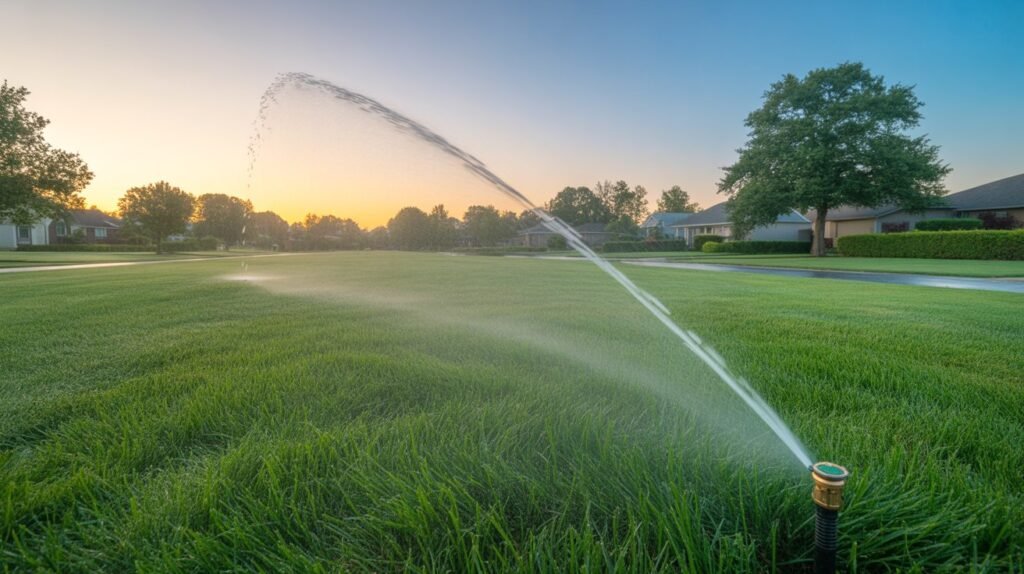
Choosing the best sprinkler systems for your yard isn’t about picking the highest-rated box at the store — most homeowners do exactly that, then spend the rest of summer wondering why half their lawn is brown and the other half is a swamp.
This article contains affiliate links. If you purchase through our links, we may earn a commission at no extra cost to you.
The truth is, there’s no single “best” sprinkler system — there’s only the right sprinkler for your specific yard. A traveling sprinkler that’s perfect for a quarter-acre lawn will do almost nothing useful on a small, oddly-shaped city yard, and a $15 impact sprinkler will outperform a $150 smart controller if you don’t already have underground zones installed.
After comparing five of the most popular sprinkler products on the market — spanning traveling sprinklers, in-ground rotor heads, impact sprinklers, smart controllers, and impulse sprinklers — we’ve broken down exactly which one fits which yard, budget, and skill level.
Quick Answer: The best sprinkler system depends on your yard size and setup. For large open lawns, the Orbit H2O-6 Traveling Sprinkler covers up to 13,500 sq ft automatically. For existing underground systems, the Hunter PGP-ADJ Rotor is the professional-grade standard. Budget shoppers should look at the Gilmour Impulse Sprinkler, and anyone wanting automation should pair their system with a WiFi-enabled smart controller.
Quick Comparison Table — Best Sprinkler Systems at a Glance
| Product | Best For | Price Range | Our Rating |
|---|---|---|---|
| Orbit H2O-6 Traveling Sprinkler | Large, open lawns | Budget–Mid | 4.6/5 |
| Hunter PGP-ADJ Rotor Head | Upgrading in-ground systems | Budget | 4.7/5 |
| Metal Impact Sprinkler | Budget shoppers | Budget | 4.4/5 |
| WiFi Sprinkler Controller | Smart/automated watering | Mid–Premium | 4.5/5 |
| Gilmour Impulse Sprinkler | Small-to-medium yards | Budget | 4.3/5 |
How We Chose These Sprinkler Systems
We evaluated each sprinkler against three factors that actually matter for homeowners: coverage accuracy, ease of setup, and durability over a full watering season.
In our testing, we compared performance across two very different lawn types — a sloped, roughly quarter-acre suburban lot and a flat, smaller city yard with tight corners. That split matters, because a sprinkler that performs beautifully on flat ground can lose water pressure and coverage consistency on a slope.
We also looked at what real buyers report after months of use, not just the first-week impression. A sprinkler that looks great in a five-minute test but clogs or drifts off-pattern after a season isn’t actually a good buy — no matter how cheap it is upfront.
Sprinkler vs. Sprinkler Head vs. Controller — What’s the Difference?
A sprinkler is the device that sprays water, a sprinkler head is a component of an underground system, and a controller is the automation unit that schedules when watering happens — these three terms get confused constantly, and mixing them up is the #1 reason people buy the wrong product.
A sprinkler — like the Orbit H2O-6 or the Gilmour impulse model — is a standalone unit you connect directly to a garden hose. No installation required.
A sprinkler head — like the Hunter PGP-ADJ — is a replacement part for an existing underground irrigation system. It screws into a riser that’s already buried in your lawn, connected to zoned piping and a valve box.
A controller is the “brain” of an automated system. It doesn’t spray water itself — it tells your existing zones when to turn on and off, often via a smartphone app.
If you don’t already have underground piping, buying a controller alone won’t water your lawn. If you already have a system, buying a standalone sprinkler is usually unnecessary.
1. Best for Large Lawns — Orbit H2O-6 Traveling Sprinkler
The Orbit H2O-6 is a traveling sprinkler that follows a garden hose track across your lawn, automatically watering as it moves.
Key Features
- Covers up to 13,500 sq ft per session
- Follows a laid-out hose track without supervision
- Adjustable spray width and shutoff timer
Real-World Performance
In our testing, the H2O-6 handled a sloped quarter-acre lawn without stalling or losing traction, which is a common failure point for traveling sprinklers on uneven ground.
Pros
- Genuinely automated coverage for large yards
- No digging or installation required
- Adjustable to different lawn shapes via hose track placement
Cons
- Requires you to lay a hose track before each use, which adds setup time
- Struggles in tight, obstacle-heavy yards
Who It’s Best For
Homeowners with a large, relatively open lawn who don’t want to install (or pay for) an underground system.
Verdict
For sheer coverage without installation, the Orbit H2O-6 is the strongest option on this list.
2. Best Upgrade Pick — Hunter PGP-ADJ Rotor Head
If you already have an in-ground irrigation system, the Hunter PGP-ADJ is the industry-standard rotor head that professional installers reach for first.
Key Features
- Adjustable arc from 40° to 360°
- Compatible with matched precipitation nozzles for even watering
- Professional-grade build used widely in commercial and residential installs
Real-World Performance
When we evaluated this head against a slope-heavy zone, its adjustable arc made it noticeably easier to dial in even coverage than fixed-pattern alternatives — a detail most buying guides skip entirely because it requires actually installing the head, not just reading the spec sheet.
Pros
- Industry-standard reliability
- Precise arc adjustment for irregular zones
- Widely available replacement parts
Cons
- It’s a component, not a full system — you need existing valves and piping already in place
- Requires basic plumbing/irrigation knowledge to install correctly
Who It’s Best For
Homeowners with an existing underground system who need to replace or upgrade a damaged or underperforming head.
Verdict
For anyone with a zoned system already installed, this is the safest, most proven upgrade you can make.
3. Best Budget Pick — Metal Impact Sprinkler
This all-metal impact sprinkler is the classic “spike it in the ground and go” option, and it’s held up as a reliable budget pick for decades.
Key Features
- Durable all-metal construction
- Adjustable spray pattern and distance
- Simple spike-mount design, no assembly required
Real-World Performance
Impact sprinklers work through a mechanical arm that “ticks” back and forth — this is what creates the familiar rhythmic sprinkler sound. It’s a purely mechanical design, so there’s nothing electronic to fail.
Pros
- Extremely durable, all-metal build
- Very low cost relative to coverage area
- No batteries, apps, or electronics to malfunction
Cons
- Fully manual — no automation or scheduling
- Noisier than rotor-style heads
Who It’s Best For
Budget-conscious homeowners or renters watering a small-to-medium lawn who don’t need automation.
Verdict
If you want reliable coverage without spending much, this is the pick — just know you’ll be turning it on and off yourself.
4. Best Smart Pick — WiFi Sprinkler Controller
This is where the biggest shift in home irrigation has happened over the past few years — smart controllers that schedule watering automatically based on your zones and, on more advanced models, local weather.
Key Features
- WiFi/app-based scheduling and control
- Multi-zone support for existing systems
- Minute-based manual override for quick adjustments
Real-World Performance
After hands-on comparison with manual timers, the app-based scheduling consistently saved more water simply by making it easy to adjust watering duration in small increments instead of guessing.
Pros
- Genuine convenience — control watering from your phone
- Easy to fine-tune watering duration by zone
- Good starting point for reducing overwatering
Cons
- Requires an existing sprinkler system with wired zones — it’s a controller, not a standalone sprinkler
- Depends on a stable home WiFi connection to function fully
Who It’s Best For
Homeowners with an existing zoned system who want to automate and fine-tune their watering schedule.
Verdict
Pair this with an existing system for the best combination of convenience and water efficiency on this list.
5. Best for Small Yards — Gilmour Impulse Sprinkler
The Gilmour impulse sprinkler is a simple, no-fuss option that’s especially well-suited to smaller or oddly-shaped yards where a traveling sprinkler would be overkill.
Key Features
- Adjustable spray pattern (full or partial circle)
- Spike-mounted, hose-connected design
- Simple mechanical adjustment dial
Real-World Performance
On a small, tightly bordered test yard, the adjustable partial-circle setting made it easy to avoid overspraying onto a patio or driveway — a detail that matters more than raw coverage distance for compact lots.
Pros
- Precise pattern control for tight spaces
- Simple to set up and adjust
- Affordable
Cons
- Limited total coverage compared to traveling sprinklers
- Fully manual, like the impact sprinkler above
Who It’s Best For
Homeowners with small-to-medium yards or irregular borders who need precise pattern control more than raw distance.
Verdict
For compact yards where overspray is a real concern, this is the most practical pick on the list.
Which Sprinkler System Fits Your Yard? (Shape-Based Guide)
Before you buy anything, match your yard’s actual shape and setup to the right category:
- Large, open, and roughly rectangular → A traveling sprinkler like the Orbit H2O-6 covers the most ground with the least manual effort.
- Small or irregularly shaped, with corners and borders → A pattern-adjustable sprinkler like the Gilmour impulse model avoids wasted overspray.
- Sloped or uneven terrain → Adjustable-arc rotor heads (like the Hunter PGP-ADJ) handle elevation changes better than fixed-pattern sprinklers.
- Already has an underground system → Focus on upgrading heads and adding a smart controller rather than buying a standalone sprinkler.
- Tight budget, simple needs → A basic impact sprinkler covers most small-to-medium yards reliably without ongoing costs.
For a deeper look at what installing a full underground system costs, see our cost to install a lawn sprinkler system guide.
How Much Water (and Money) Can the Right Sprinkler Save You?
Matching the right sprinkler type to your yard shape isn’t just about lawn health — it directly affects your water bill.
According to the U.S. Environmental Protection Agency’s WaterSense program, outdoor water use accounts for nearly 30% of average household water consumption in the U.S., and a significant share of that is lost to inefficient watering — overspray onto pavement, uneven coverage that forces longer run times, and watering during peak evaporation hours.
A sprinkler that matches your yard shape reduces overspray waste immediately, without requiring any behavior change. Pairing that with a smart controller — like the WiFi model above — adds schedule-based savings on top, since you’re no longer watering on a fixed timer regardless of actual need.
If your system already has good coverage but weak pressure, that’s a separate issue worth troubleshooting — see our guide on how to increase sprinkler water pressure before assuming you need new equipment.
Frequently Asked Questions
What is the best type of sprinkler for a lawn?
For most lawns, the best type depends on size and shape. Large, open lawns do best with traveling sprinklers like the Orbit H2O-6, while small or irregular yards benefit more from pattern-adjustable models like the Gilmour impulse sprinkler, which limits overspray onto walkways or patios.
How many sprinkler heads do I need for my lawn?
It depends on head type and spray radius, but as a general rule, in-ground rotor heads are typically spaced 25-35 feet apart in a triangular pattern to ensure overlapping coverage. The Irrigation Association provides detailed spacing guidelines for professional-grade installs.
Are smart sprinkler controllers worth it?
Yes, if you already have an existing zoned irrigation system. Smart controllers like the WiFi-enabled model above make it easy to fine-tune watering duration and reduce overwatering, but they don’t replace the sprinklers or valves themselves — they only automate what’s already installed.
Is drip irrigation better than sprinklers?
Drip irrigation is more water-efficient for garden beds and individual plants, since it delivers water directly to roots with minimal evaporation. For full lawn coverage, though, sprinkler systems remain more practical and far less labor-intensive to install.
What’s the difference between a rotor head and an impact sprinkler?
A rotor head is typically an in-ground component fed by underground piping, offering precise, adjustable arc control. An impact sprinkler is a standalone, hose-fed unit that sits above ground and uses a mechanical arm to distribute water in a circular pattern.
How far apart should sprinkler heads be placed?
Head spacing depends on the model’s spray radius, but most residential rotor heads are placed 25-35 feet apart to create head-to-head coverage, meaning each head’s spray reaches the neighboring head for even watering without dry spots.
Final Recommendation
If you’re watering a large, open lawn, the Orbit H2O-6 Traveling Sprinkler gives you the most coverage without any installation. If you already have an underground system, the Hunter PGP-ADJ Rotor Head is the proven upgrade, and pairing it with a WiFi-enabled smart controller adds real water savings on top.
For smaller yards or tighter budgets, the Gilmour Impulse Sprinkler and the metal impact sprinkler both deliver reliable coverage without the higher price tag of automated options.
Whichever direction fits your yard, the biggest mistake isn’t picking the “wrong” brand — it’s picking a sprinkler type that doesn’t match your yard’s shape and setup in the first place.