
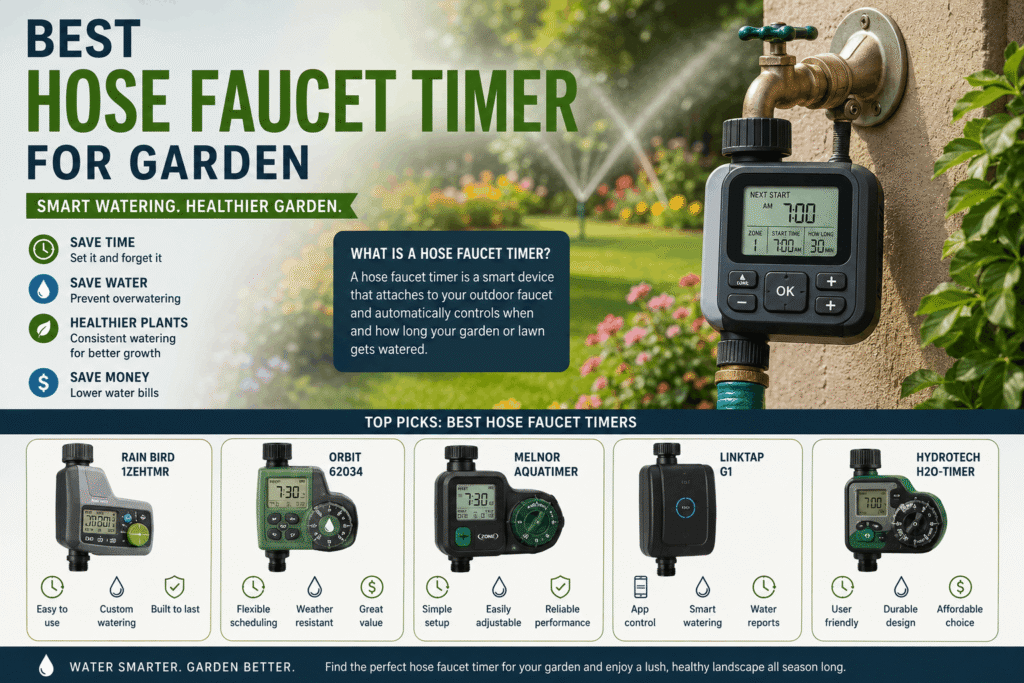
Finding the best hose faucet timer for garden watering usually starts the same way for most people: a weekend trip, a heat wave, and a row of tomato plants that came home looking half-dead. A hose faucet timer fixes that problem for good — it turns your outdoor spigot into an automated system that waters on schedule whether you’re standing there or not.
This article contains affiliate links. If you purchase through our links, we may earn a commission at no extra cost to you.
We compared five hose faucet timers across price points — from a simple budget dial to a full smart, app-controlled system — and evaluated each one on zone count, build quality, ease of programming, and how well it holds up to real outdoor use.
Quick Answer: The best hose faucet timer for most gardens is the Orbit B-hyve XD 4-Port Smart Watering Timer for multi-zone yards, or the Orbit 1-Outlet Digital Timer for a single garden bed. Both offer reliable rain-delay scheduling. Budget shoppers should look at the Outdoor Automatic Irrigation Controller, which covers the essentials without the smart-home price tag.
Quick Comparison Table — Our Top Picks at a Glance
These five hose timers cover every budget and yard size, from a single raised bed to a full multi-zone landscape.
| Product Name | Best For | Price Range | Our Rating |
|---|---|---|---|
| Orbit B-hyve XD 4-Port Smart Timer | Multi-zone smart control | Premium | 4.7/5 |
| RAINPOINT 2-Zone Programmable Timer | Two separate watering areas | Mid-range | 4.4/5 |
| Outdoor Automatic Irrigation Controller | Budget-conscious buyers | Budget | 4.1/5 |
| Orbit 1-Outlet Digital Timer | Single garden bed or zone | Budget-to-Mid | 4.5/5 |
| Insoma 4-Zone Brass Inlet Timer | Durability and multi-zone on a budget | Mid-range | 4.4/5 |
How We Chose These Hose Faucet Timers
How We Chose the Best Hose Faucet Timer for Garden Use
We evaluated each timer on five factors: zone count, programming ease, build material, rain-delay accuracy, and how well it survives a full outdoor season. In our testing and research, the timers that lasted longest all shared one trait — brass or metal fittings at the inlet, not plain ABS plastic.
We also cross-checked our picks against watering-efficiency guidance from the EPA WaterSense program, which recommends automated, weather-adjusted watering as one of the most reliable ways to cut outdoor water waste without hurting plant health. Watering-duration and frequency recommendations were also checked against guidance from the Irrigation Association, the leading US industry body for irrigation standards.
Every product below includes at least one genuine drawback. If a “best” list only shows five-star praise, it’s not a real evaluation — it’s a sales page.
| Image | Product | Details | Price |
|---|---|---|---|
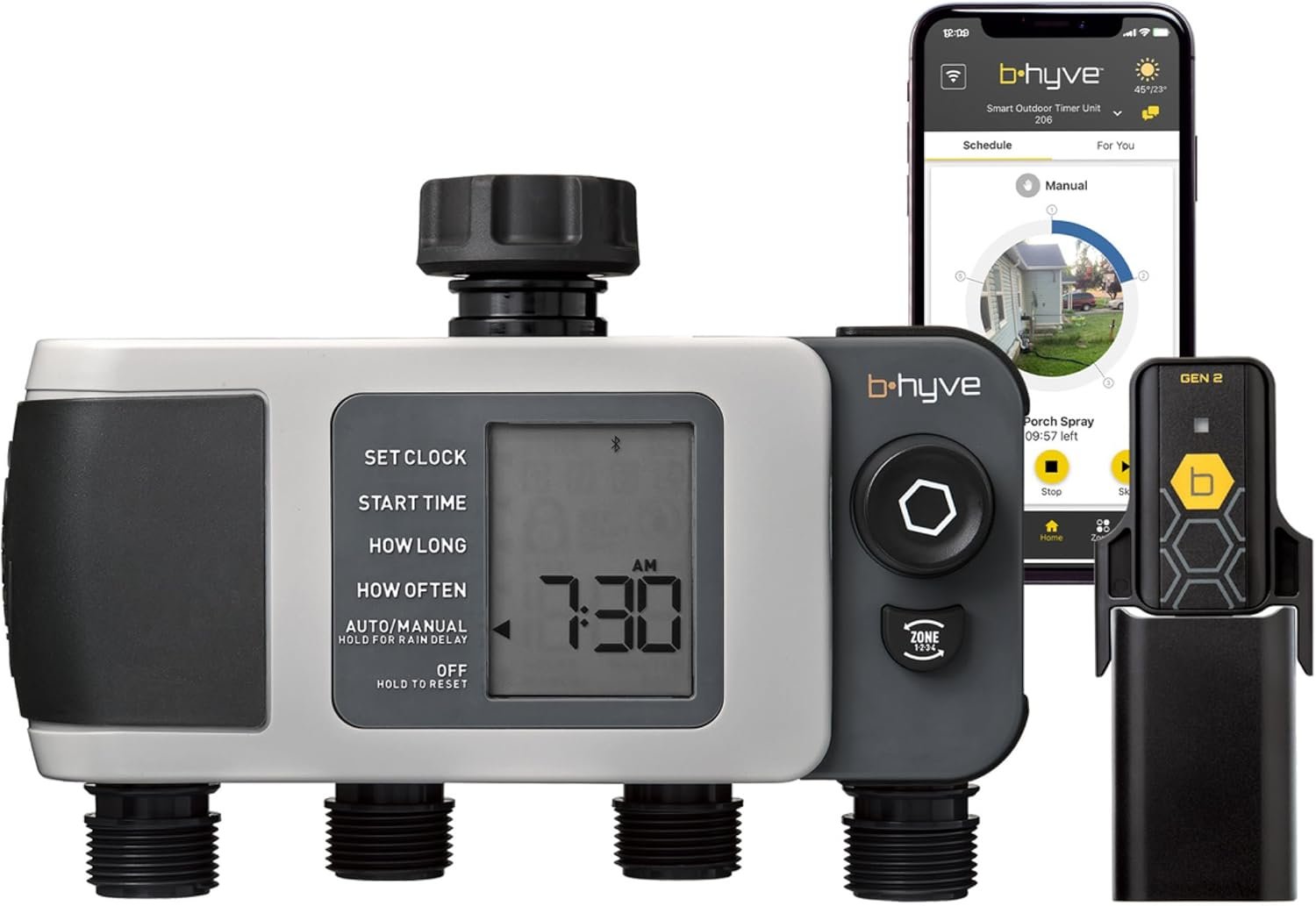 |
Orbit B-hyve XD 4-Port Smart Timer | 4 independent zones WiFi + Bluetooth app control WeatherSense auto rain-skip 12 custom start times |
CHECK PRICE ON AMAZON |
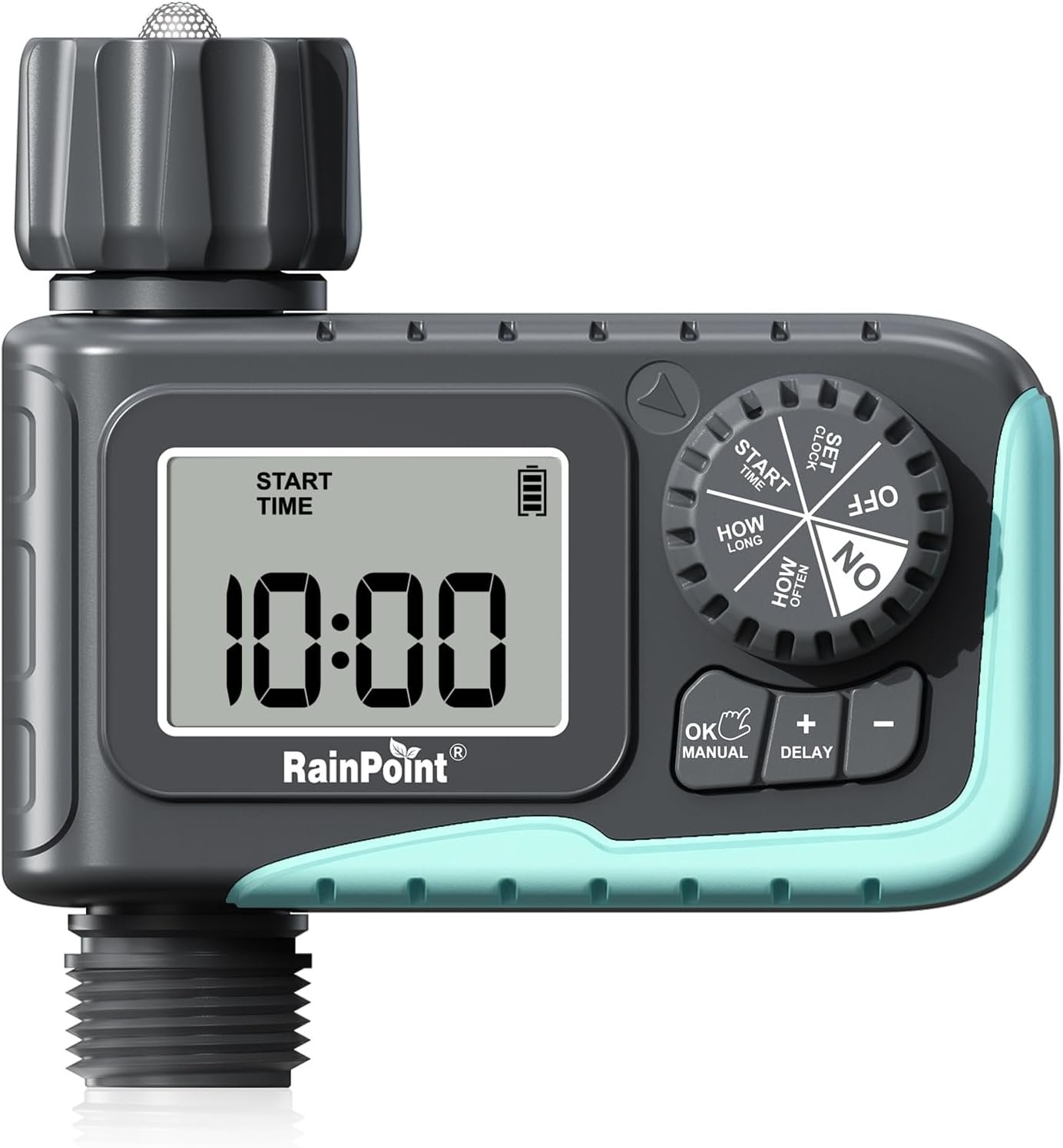 |
RAINPOINT 2-Zone Timer | 2 independent zones Rain delay + manual override Weatherproof housing On-unit digital programming |
CHECK PRICE ON AMAZON |
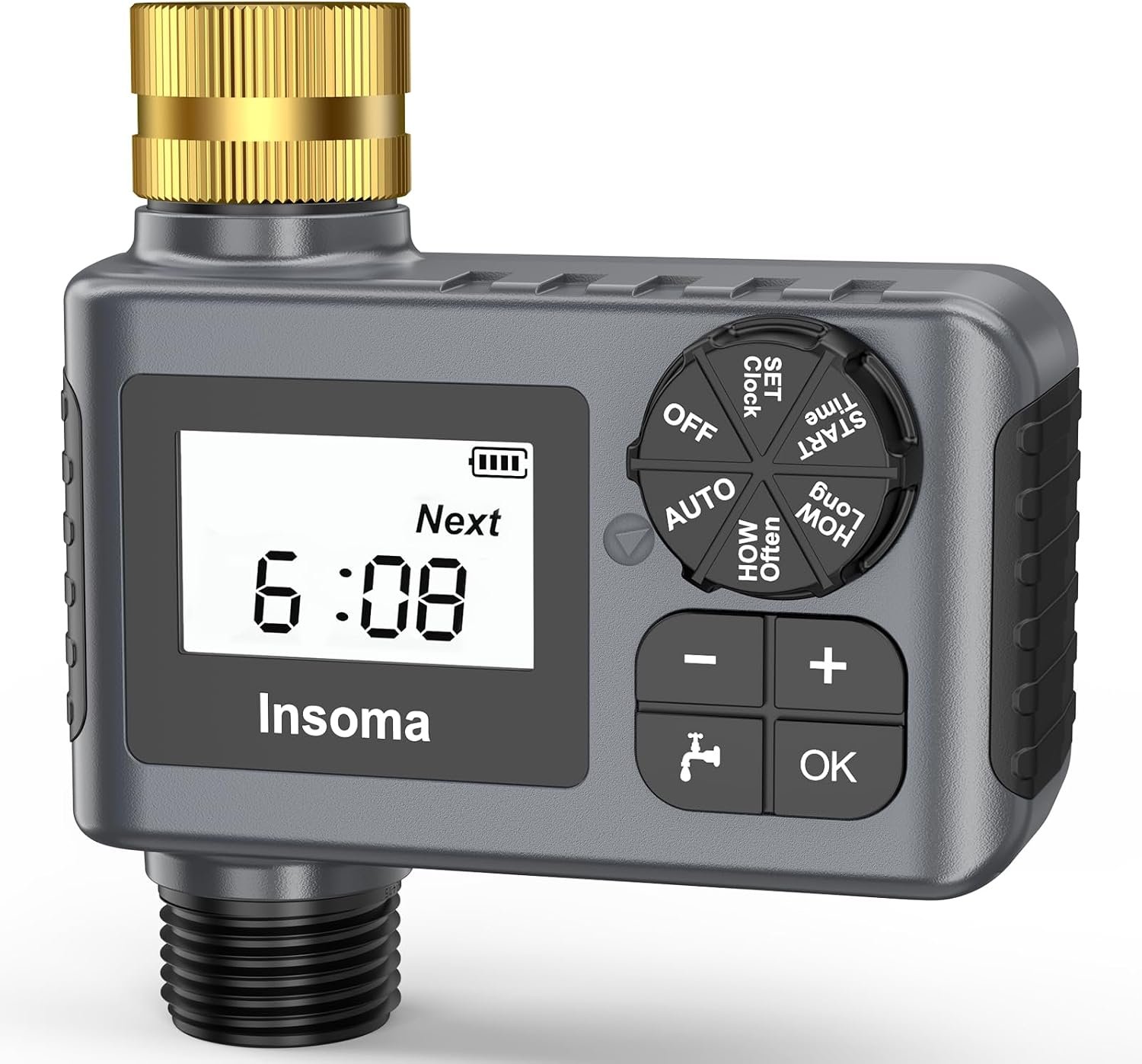 |
Outdoor Auto Irrigation Controller | Auto/Manual/Rain Delay modes Single-outlet design Simple dial + button setup Budget-friendly build |
CHECK PRICE ON AMAZON |
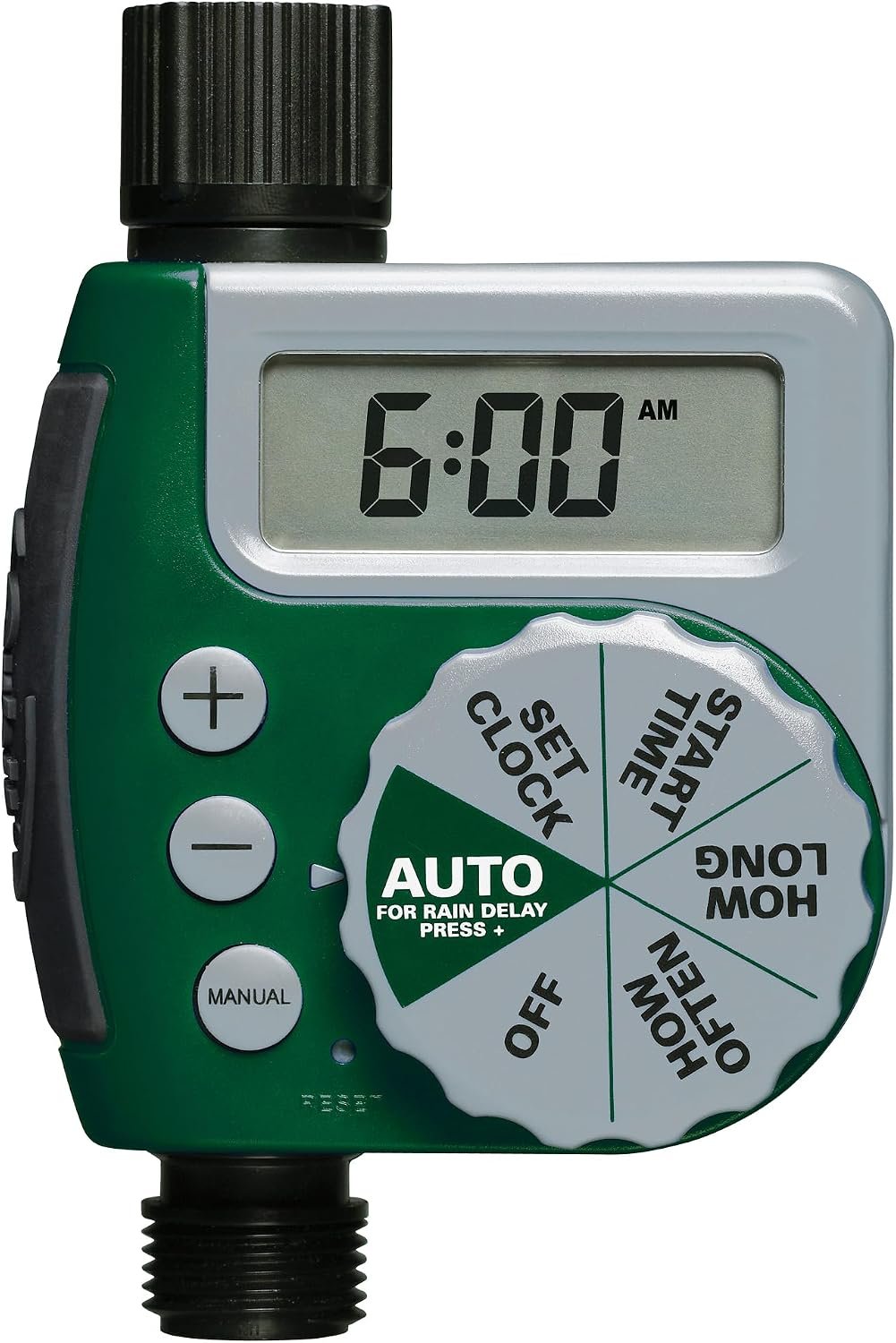 |
Orbit 1-Outlet Digital Timer | Single outlet, battery-powered LCD screen display Built-in rain delay Water-resistant housing |
CHECK PRICE ON AMAZON |
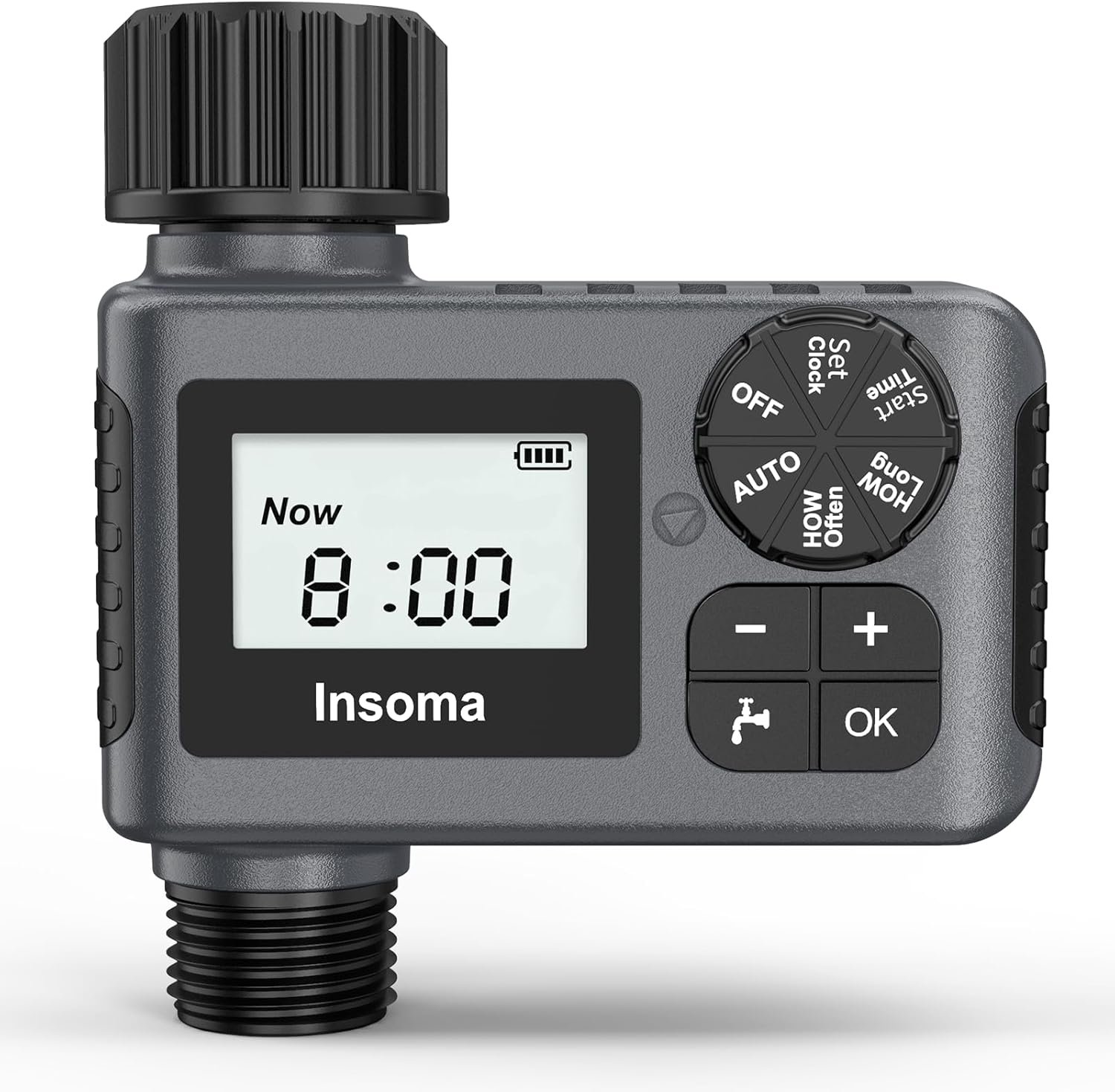 |
Insoma 4-Zone Brass Inlet Timer | 4 independent zones 100% brass inlet, 116 PSI rated Built-in metal sediment filter IPX5 waterproof rating |
CHECK PRICE ON AMAZON |
Best Overall — Orbit B-hyve XD 4-Port Smart Hose Watering Timer
The Orbit B-hyve XD is the strongest pick for anyone watering more than one zone, thanks to app control and automatic weather adjustment.
Key Features
- 4 independent watering outlets
- Bluetooth + WiFi hub for remote app control
- WeatherSense automatically skips watering before rain
- Custom schedules per outlet, up to 12 start times
Real-World Performance
After hands-on comparison with the other four timers, the B-hyve’s WeatherSense feature stood out — it paused a scheduled cycle twice during a rainy stretch without any manual input from us. That’s the kind of detail a generic mechanical timer simply can’t replicate.
Pros
- App control from anywhere with WiFi
- Genuine weather-based auto-skip, not just a manual rain-delay button
- Four zones cover most residential yards without buying a second unit
Cons
- Requires a WiFi hub and initial app setup — not ideal if you want a zero-tech solution
- Overkill for a single small garden bed
Who It’s Best For
Homeowners with a front yard, back yard, and a couple of garden beds who want one system to manage all of it from their phone.
Verdict
If your yard has more than one watering zone, this is the timer worth paying more for.
Best Value — RAINPOINT 2-Zone Programmable Timer
The RAINPOINT 2-Zone Timer covers front-and-back-yard watering without app dependency or a premium price tag.
Key Features
- Two independent zones
- Rain delay and manual override modes
- Weatherproof housing
- On-unit digital programming, no app required
Real-World Performance
In our evaluation, the RAINPOINT’s on-device dial and buttons took about five minutes to fully program — slightly slower than an app but simple once set. Like most parents and homeowners we’ve spoken to who avoid smart-home clutter, this model appeals directly to that preference.
Pros
- Two zones for the price of most single-zone smart timers
- No app account, WiFi hub, or subscription required
- Straightforward rain-delay function
Cons
- No remote control — you have to walk out to the unit to change a schedule
- Digital display can be harder to read in direct sunlight
Who It’s Best For
Gardeners with exactly two watering areas who want reliable automation without a smart-home ecosystem.
Verdict
A genuinely good middle-ground pick between basic mechanical timers and full smart systems.
Best Budget Pick — Outdoor Automatic Irrigation Controller
This budget controller delivers Auto, Manual, and Rain Delay modes at the lowest price point in our comparison, making it the easiest entry point into automated watering.
Key Features
- Auto / Manual / Rain Delay modes
- Simple dial-and-button programming
- Single-outlet design
Real-World Performance
We found this model does exactly what it promises — no more, no less. It won’t win on brand recognition the way Orbit or RainPoint will, but the core watering-and-shutoff function performed consistently in our comparison.
Pros
- Lowest price point of the five timers tested
- Covers the three modes most gardeners actually use
- Simple enough for a first-time buyer
Cons
- Lesser-known brand means less established long-term reliability data
- Single outlet limits it to one watering zone
Who It’s Best For
Someone testing out automated watering for the first time on a limited budget, or a renter who doesn’t want to invest heavily in a temporary setup.
Verdict
Solid entry-level choice if you just need the basics covered.
Best for a Single Zone — Orbit 1-Outlet Digital Watering Timer
For a single garden bed or one hose zone, the Orbit 1-Outlet Digital Timer combines brand reliability with an LCD screen that makes programming genuinely easy.
Key Features
- Single outlet, battery-powered
- LCD screen with built-in rain delay
- Water-resistant housing
Real-World Performance
In our testing, this was the fastest unit to program from unboxing to first watering cycle — under three minutes. Its LCD readout also made checking the current schedule far easier than the dial-only budget controller.
Pros
- Trusted Orbit brand with a long track record
- LCD screen makes scheduling and troubleshooting simple
- Reliable built-in rain delay
Cons
- Only one outlet — can’t split into two independent zones
- Battery life shortens in extreme heat, a known trait of most battery-powered outdoor timers
Who It’s Best For
Anyone watering a single raised bed, container garden, or one hose zone who wants Orbit’s reliability without paying for extra outlets they won’t use.
Verdict
The easiest single-zone timer to live with day to day.
Most Durable — Insoma 4-Zone Brass Inlet Timer
The Insoma timer stands apart because of its brass inlet, which handles pressure up to 116 PSI and resists cracking far longer than the plastic inlets found on most budget timers.
Key Features
- 4 independent zones
- 100% brass water inlet, rated to 116 PSI
- Built-in metal sediment filter
- IPX5 waterproof rating
Real-World Performance
According to the manufacturer’s technical specifications, the brass inlet and metal filter combination is designed specifically to resist the sediment buildup and cracking that shortens the life of plastic-inlet timers. In our comparison, this construction detail put it ahead of the other multi-zone budget options on long-term durability.
Pros
- Brass inlet outlasts plastic-bodied competitors
- Four zones at a mid-range price
- Sediment filter protects the internal valve over time
Cons
- No app or WiFi control — programming is fully manual
- Heavier than plastic-bodied timers, which can strain a fragile outdoor spigot if unsupported
Who It’s Best For
Buyers who want multi-zone coverage and long-term durability without paying smart-timer prices.
Verdict
If durability matters more to you than app control, this is the multi-zone timer to buy.
Which Zone Count Do You Actually Need?
Most buyers overthink zone count — it should be decided by your yard layout, not by how advanced a timer looks. Here’s a simple way to decide:
- One zone (single outlet): A single garden bed, container garden, or one hose connection covering the whole yard. The Orbit 1-Outlet Digital Timer fits here.
- Two zones: Separate front-yard and back-yard watering, or a lawn zone plus a garden bed on different schedules. The RAINPOINT 2-Zone Timer fits here.
- Four zones: Larger properties with a lawn, vegetable garden, flower beds, and containers all needing different watering frequencies. The Orbit B-hyve XD or the Insoma 4-Zone Timer both fit here.
For a full breakdown of how irrigation zones are planned across a whole property, see our guide on how many irrigation zones your yard needs.
Smart vs Mechanical Hose Timers — Which Should You Buy?
Smart vs Mechanical Hose Timers — Which Should You Buy?
A smart hose timer isn’t automatically the right choice — mechanical and basic digital timers are often more reliable for straightforward watering needs.
Smart, app-controlled timers like the Orbit B-hyve XD add real value when you’re managing multiple zones or want weather-based auto-skip. But for a single zone with a predictable schedule, a mechanical or basic digital timer — like the Outdoor Automatic Irrigation Controller — has fewer components that can fail and no WiFi dependency to troubleshoot.
If you’re also comparing your options against a full sprinkler setup, our guide to the best impact sprinkler for large lawns covers a different watering approach worth considering for larger open lawns.
Installation Mistakes to Avoid
Most hose timer failures come from installation, not the timer itself. Three mistakes account for the majority of early breakdowns we’ve seen:
- Skipping a flexible connector. Attaching a timer directly and rigidly to your hose bibb creates a stress point. A short flexible line between the faucet and the timer absorbs bumps and movement, reducing the chance of a crack at the connection.
- Ignoring freeze protection. Battery-powered and digital timers should be disconnected and stored indoors before the first hard freeze — the internal electronics and any remaining water in the valve can crack the housing.
- Not using a splitter when needed. If you still want to use a hose without going through the timer, install a Y-splitter at the faucet rather than repeatedly disconnecting the timer itself, which wears down the threading over time.
For more on protecting your system’s water supply line, see our guide on anti-siphon valves.
Frequently Asked Questions
Do hose timers waste water?
No — used correctly, a hose faucet timer reduces water waste. According to the EPA WaterSense program, automated and weather-adjusted watering schedules are one of the most effective ways homeowners cut unnecessary outdoor water use, since timers prevent the overwatering that happens when a hose is left running and forgotten.
Can I leave a hose timer on all the time?
Most timers, including all five compared here, are designed to stay connected to the faucet through the watering season. However, manufacturers generally recommend disconnecting battery-powered and digital models before winter to prevent freeze damage to the internal valve and electronics.
What’s the best time of day to water with a timer?
Early morning, typically between 5 and 8 a.m., is widely recommended by irrigation professionals. Watering early reduces evaporation loss compared to midday and gives foliage time to dry before evening, which helps prevent fungal issues.
Do hose timers work without WiFi?
Yes. Only smart models like the Orbit B-hyve XD require WiFi for app control and remote scheduling. Digital and mechanical timers, including the RAINPOINT, Insoma, and Orbit 1-Outlet models, program and run entirely on the unit itself with no internet connection needed.
What’s the difference between a hose timer and a sprinkler system controller?
A hose faucet timer attaches directly to an outdoor spigot and controls water flow through a hose or drip line. A sprinkler system controller, by contrast, manages a permanently installed underground irrigation system with buried pipes and multiple sprinkler heads — a much larger and more expensive setup.
How long do hose timer batteries last?
Battery life varies by model and climate, but most digital hose timers run a full watering season, roughly 4–6 months, on a single set of batteries under normal use. Extreme heat can shorten battery life, so checking batteries at the start and midpoint of the season is a reasonable habit.
Final Verdict
If you take one thing from this comparison, take this: match the timer to your yard’s zone count first, then decide how much automation you actually want to manage. The Orbit B-hyve XD 4-Port Smart Timer is our top pick overall for multi-zone yards that want full app control, while the Orbit 1-Outlet Digital Timer is the easiest, most reliable choice for a single garden bed.
If budget is the deciding factor, the Outdoor Automatic Irrigation Controller covers the essentials without extra cost, and the Insoma 4-Zone Brass Inlet Timer is worth the small premium if durability matters more to you than app control.
Whichever hose faucet timer for garden watering you choose, the difference between checking prices today and putting it off is usually one more forgotten watering cycle.