
Introduction
How much PSI to blow out sprinkler system is one of the most important questions homeowners ask before winter arrives. If you get this wrong, your sprinkler system can suffer serious damage when temperatures drop.
Many homeowners make one big mistake—they either use too much pressure or not enough. Both can lead to expensive repairs. Too little PSI leaves water behind, while too much PSI can burst pipes or destroy sprinkler heads. it’s important to understand the basics like how to turn on a hydro sprinkler system
The good news? You don’t need to be an expert to do this correctly. With the right pressure, tools, and steps, you can safely winterise your system and avoid damage.According to the United States Environmental Protection Agency, efficient irrigation practices not only protect your system but also help conserve water.
Table of Contents
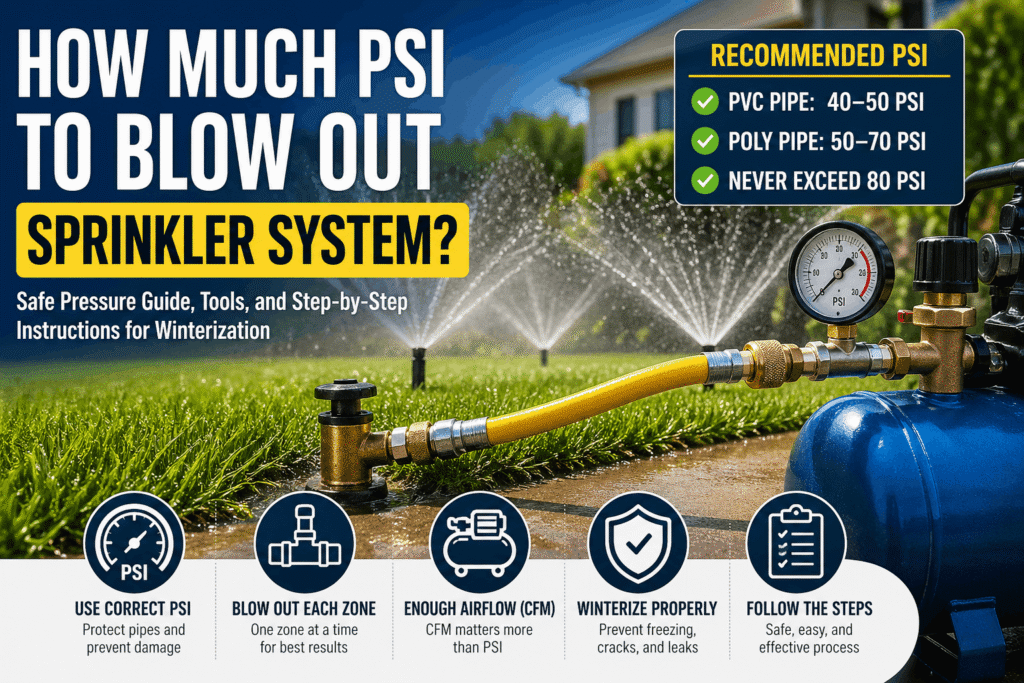
How Much PSI to Blow Out Sprinkler System? (Quick Answer)
The correct answer depends on your pipe type, but here’s a quick guideline:
- PVC pipes: 40–50 PSI (maximum safe range)
- Poly pipes: 50–80 PSI
- Never exceed 80 PSI for any residential system.
Most experts recommend staying on the safer side:
- Use 50 PSI for PVC systems
- Use 60–70 PSI for poly systems
Always check your sprinkler system manual before starting.
Why PSI Matters When Blowing Out a Sprinkler System
PSI (pounds per square inch) controls how forcefully air moves through your system. But here’s the key:
Airflow (CFM) matters more than pressure—but PSI still matters for safety.
If PSI is too low:
- Water stays inside pipes
- Freezing causes cracks
- System may fail in spring
If PSI is too high:
- Pipes can burst instantly
- Sprinkler heads can break
- Valves can get damaged.
Think of it like this:
You don’t need extreme force—you need controlled pressure with steady airflow.
Recommended PSI Based on Pipe Type
Different sprinkler systems use different materials, and each handles pressure differently.
H3: PVC Pipe Systems
PVC (rigid plastic) is common in residential systems.
Safe PSI Range:
- 40–50 PSI (ideal range)
Why lower PSI?
- PVC is strong but brittle under pressure.
- High PSI can crack or split pipes.
Best practice: Stay around 50 PSI maximum
H3: Polyethylene (Poly) Pipe Systems
Poly pipes are flexible and more durable.
Safe PSI Range:
- 50–80 PSI
Why is higher PSI okay?
- Flexible material absorbs pressure
- Less risk of cracking
Best practice: Use 60–70 PSI for safety and efficiency.
Tools You Need to Blow Out a Sprinkler System
Before starting, ensure you have the right equipment.
Essential tools:
- Air compressor (high CFM preferred)
- Air hose
- Blowout adapter fitting
- Pressure regulator (very important)
- Safety goggles
- Gloves
Optional but helpful:
- Hearing protection
- Moisture filter
- Important: A small compressor may not work well for large systems. If you are new, you should first learn How to install a sprinkler irrigation system so you understand how the system is connected before using an air compressor. Leading irrigation brand Rain Bird also emphasizes that using a pressure regulator is essential to maintain safe PSI levels.
Step-by-Step Guide to Blow Out Your Sprinkler System
Follow these steps carefully to safely blow out your system.
Step 1 – Turn Off Water Supply
- Shut off the main irrigation valve
- Prevent new water from entering the system
Step 2 – Attach Air Compressor
- Connect compressor to blowout port
- Use proper adapter fitting
- Ensure tight connection
Step 3 – Set Correct PSI
This step is where most people go wrong.
- Set PSI based on pipe type:
- PVC: 40–50 PSI
- Poly: 50–70 PSI
Never guess—always adjust carefully.
Step 4 – Blow Out One Zone at a Time
- Turn on one zone manually
- Let air push water out
- Watch sprinkler heads until only mist appears
Do NOT run multiple zones at once.
Step 5 – Repeat for All Zones
- Move zone by zone
- Repeat until the system is fully dry
Step 6 – Final Check
- Ensure no water remains
- Disconnect compressor
- Store equipment
What Size Air Compressor Do You Need?
Many people focus only on PSI, but that’s not enough.
The real key is CFM (Cubic Feet per Minute).
Recommended CFM:
- Small system: 10–20 CFM
- Medium system: 20–30 CFM
- Large system: 30+ CFM
Why CFM matters:
- It pushes water out effectively.
- Prevents repeated cycles
- Saves time
A small pancake compressor may struggle for full systems.
Common Mistakes to Avoid
Avoid these mistakes to protect your sprinkler system:
Using too much PSI
- Can destroy pipes instantly
Blowing all zones together
- Reduces airflow efficiency
- Leaves water behind
Using a small compressor
- Not enough airflow
Skipping zones
- Leaves trapped water
Not wearing safety gear
- Risk of injury from debris
Always follow safe PSI limits when learning how much PSI to blow out the sprinkler system.
Should You DIY or Hire a Professional?
This depends on your system size and experience.
DIY is good if:
- Small to medium system
- You have proper tools.
- You understand PSI settings
Hire a professional if:
- Large or complex system
- No air compressor available
- Not confident with pressure settings
Average cost:
- $50–$150 (one-time service)
Sometimes hiring a pro is cheaper than repairing damage.
How Long Does It Take to Blow Out a Sprinkler System?
The time depends on system size.
Average time:
- Small system: 20–30 minutes
- Medium system: 30–45 minutes
- Large system: 45–60 minutes
Factors affecting time:
- Number of zones
- Compressor size
- Water pressure
Rushing the process can leave water behind.
Conclusion
Knowing how much PSI to blow out the sprinkler system is the key to protecting your irrigation system during winter. To fully protect your system, combine this guide with How to Winterise a Sprinkler System for long-term durability and performance. Experts from Colorado State University Extension suggest that improper blowout techniques can lead to pipe damage, so beginners should proceed carefully
To stay safe:
- Use 40–50 PSI for PVC pipes.
- Use 50–70 PSI for poly pipes
- Never exceed 80 PSI
Always focus on controlled pressure and steady airflow, not maximum force.
If you follow the correct steps and avoid common mistakes, your sprinkler system will stay safe and ready for the next season.
(FAQs)
1. What is the best PSI to blow out a sprinkler system?
The best PSI is:
- 40–50 PSI for PVC
- 50–70 PSI for poly
2. Can I use 100 PSI to blow out my sprinkler system?
No. Using 100 PSI is dangerous and can damage pipes, valves, and sprinkler heads.
3. What happens if PSI is too low?
Water remains inside pipes, which can freeze and crack the system.
4. Do I need a big air compressor?
Yes, you need a compressor with enough CFM. Small compressors may not remove all water.
5. Should I blow out all zones at once?
No. Always blow out one zone at a time for best results.
6. How many times should I blow out each zone?
Usually 1–2 times until only air (mist) comes out.
7. When should I blow out my sprinkler system?
Before the first freeze, typically in late fall.