
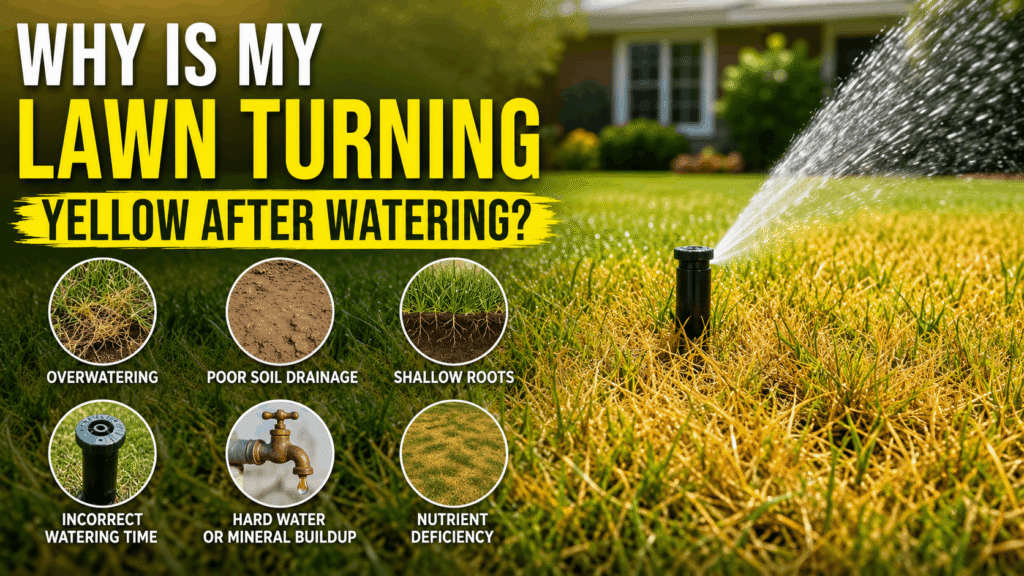
You watered your lawn expecting greener grass, but the lawn started turning yellow instead. That is frustrating, especially when more watering seems like the obvious fix.
Quick Answer: Yellow grass after watering can result from overwatering, underwatering, poor drainage, uneven sprinkler coverage, nutrient problems, pests, disease, heat, or natural dormancy. Check the soil moisture and yellowing pattern before watering again. More water is not automatically the solution, especially when the soil is already staying wet.
Table of Contents
What You Need to Know
- Yellow grass does not automatically mean the lawn needs more water.
- Wet soil plus yellow grass can point toward excessive watering or poor drainage.
- Dry soil plus yellow grass can indicate insufficient water reaching the grass.
- A distinct yellow pattern can reveal uneven sprinkler coverage.
- If watering changes do not solve the problem, investigate nutrients, pests, disease, heat, or dormancy.
Why Is My Lawn Turning Yellow After Watering?
Watering can expose an existing lawn problem rather than cause the yellowing itself. The fastest way to narrow down the cause is to check soil moisture, observe the pattern of yellow grass, and inspect how evenly water reaches the lawn.
A lawn that stays wet after watering deserves a different response from a lawn that remains dry. Increasing watering without checking the soil can make the wrong problem worse.
Is your lawn overwatered or underwatered?
Overwatering means the lawn receives more water than the soil and grass can effectively use. Underwatering means the grass does not receive enough usable moisture.
| What you observe | More likely direction | What to check | First response |
|---|---|---|---|
| Yellow grass + consistently wet soil | Excess moisture | Soil and drainage | Check before watering again |
| Yellow grass + dry soil | Insufficient water | Soil moisture and coverage | Check whether water reaches the area |
| Yellow patches following a sprinkler pattern | Uneven watering | Sprinkler coverage | Inspect sprinkler heads |
| Yellowing with additional lawn symptoms | Non-watering problem | Pests, disease, nutrients or stress | Investigate before adding water |
Save or screenshot this Yellow Lawn Troubleshooting Table — it covers the quickest checks for separating watering problems from other causes.
What Are the Common Reasons Grass Turns Yellow After Watering?
Yellow grass after watering has several possible causes, so the visible color alone cannot identify the problem. Start with watering and drainage, then consider other causes if the soil and sprinkler coverage look normal.
Is too much water turning your grass yellow?
Too much water can leave soil consistently saturated and prevent the lawn from maintaining healthy root conditions. Frequent watering can be especially problematic when drainage is poor.
Do not respond to yellow grass by automatically increasing the watering schedule. First determine whether the soil is already holding substantial moisture.
Is water failing to reach some parts of the lawn?
A lawn can appear adequately watered while individual areas receive very little water. Sprinkler placement, blocked sprinkler heads, damaged equipment, or poor coverage can create dry yellow patches.
Look at the location of the yellowing. If the yellow areas follow a recognizable watering pattern, inspect the sprinkler coverage before changing the entire lawn’s watering routine.
Can poor drainage cause yellow grass?
Poor drainage can keep the soil wet even when the watering schedule does not appear excessive. Low areas, compacted soil, and areas where water collects deserve particular attention.
Check whether water remains in the same area after the rest of the lawn has dried. Persistent wetness points toward a drainage issue that simply changing the watering schedule may not solve.
Can nutrients cause yellow grass?
Yes. Nutrient problems can produce yellowing even when watering is appropriate.
If the lawn has adequate moisture and reasonably even sprinkler coverage but continues to yellow, consider soil and nutrient conditions rather than assuming the lawn needs more water.
Can pests or lawn disease cause yellowing?
Yes. Pests and lawn diseases can cause discoloration that looks similar to a watering problem.
Look for additional symptoms rather than diagnosing the cause from yellow color alone. If the lawn continues deteriorating after obvious watering problems are corrected, a more detailed diagnosis may be necessary.
Can heat or dormancy turn grass yellow?
Environmental stress can also change lawn color. Heat and natural dormancy can make grass appear yellow or brown even when watering is not the primary problem.
The timing, location, soil condition, and other visible symptoms should all be considered before changing irrigation.
How Can You Find the Actual Cause of Yellow Grass?
A short inspection is more useful than immediately changing your watering schedule. Follow the same sequence each time so you do not accidentally treat the wrong cause.
Reason: USDA NRCS provides practical lawn-irrigation guidance, including checking when to irrigate, avoiding runoff, and measuring water application.
USDA NRCS — Lawn Irrigation Guide
1. Check the soil moisture first
Examine the soil in the yellow area and compare it with a healthy-looking section of lawn.
The key question is simple: Is the soil unusually wet, reasonably moist, or dry?
Do not assume that a recent watering means the roots received the right amount of usable moisture.
2. Look at the pattern of yellowing
Observe whether yellow grass appears as:
- isolated patches,
- broad sections,
- areas around sprinkler heads,
- strips or arcs,
- low areas where water collects,
- or areas unrelated to sprinkler coverage.
The pattern can tell you where to investigate next.
3. Check sprinkler coverage
Inspect the sprinkler heads serving the yellow area.
Look for blocked heads, damaged heads, poor positioning, or areas that receive noticeably different coverage. A sprinkler system can water the lawn regularly while still distributing water unevenly.
an existing HydroSprinkler article specifically covering
After watering, watch the affected area rather than immediately watering again.
If the same location remains noticeably wetter than surrounding lawn, investigate drainage before increasing or repeating irrigation.
5. Look for symptoms unrelated to watering
If moisture and sprinkler coverage look reasonable, examine the grass for other signs of stress.
Yellowing that persists despite correcting obvious irrigation problems deserves further investigation instead of repeated watering changes.
What Should You Do If Your Lawn Is Yellow After Watering?
The safest first move is to diagnose the moisture problem before adding more water.
1. Do not automatically water again
Yellow grass is not proof that the lawn is thirsty.
Check the soil first. If the soil is already staying wet, additional watering is unlikely to be the appropriate first response.
2. Identify whether moisture is excessive or insufficient
Compare the yellow area with healthy grass nearby.
A difference in soil moisture can help determine whether the problem is associated with watering or whether another cause deserves attention.
3. Correct obvious sprinkler problems
If one section is receiving substantially different coverage, inspect the sprinkler equipment serving that area.
[CONTENT GAP: Link to an existing HydroSprinkler sprinkler-head or sprinkler-system troubleshooting article.]
4. Monitor the lawn after the correction
Avoid making several major changes simultaneously.
If you change watering, drainage, fertilizer, and other conditions at the same time, you make it harder to determine which change affected the lawn.
5. Investigate persistent yellowing
If the lawn continues to deteriorate after obvious watering problems have been addressed, consider causes beyond irrigation.
A persistent problem may require a more specific lawn diagnosis.
What Is the Best Way to Prevent Yellow Grass From Coming Back?
Prevention starts with matching watering to the lawn’s actual conditions rather than following a fixed routine without checking the grass and soil.
A practical routine includes:
- Check soil conditions before watering.
- Watch for areas that remain unusually wet.
- Inspect sprinkler coverage when yellow patches appear.
- Adjust watering when conditions change.
- Investigate recurring yellow patches instead of repeatedly increasing water.
The surprising part is that watering more can be the wrong response to a lawn that looks thirsty. A yellow lawn can have a watering problem without having a simple “not enough water” problem.
Can a simple watering checklist help?
If you are repeatedly dealing with yellow patches, recording watering changes and lawn symptoms can make troubleshooting easier.
[EMAIL CAPTURE POINT: Offer a genuine HydroSprinkler lawn-watering checklist here if you have one, so readers can track soil conditions, sprinkler coverage, and watering changes over time.]
Could Your Sprinkler System Be Causing the Problem?
If yellowing follows the pattern of your sprinkler coverage, the watering equipment deserves inspection before you change the entire lawn’s watering schedule.
Check the sprinkler heads, coverage and timer settings serving the affected area. The goal is to determine whether different sections of the lawn are receiving substantially different amounts of water.
Once the problem has been identified as a coverage or watering-equipment issue, a suitable sprinkler head, timer, or irrigation component can become part of the solution.
relevant HydroSprinkler commercial sprinkler
What Are the Most Common Mistakes When Fixing Yellow Grass?
The biggest mistake is treating yellow color as proof that the lawn needs more water.
Mistake 1: Watering again without checking the soil
A recently watered lawn may already have sufficient moisture. More water can move you farther from the actual solution.
Mistake 2: Changing the whole irrigation system because of one patch
One yellow area may have a localized sprinkler, drainage, or soil problem.
Check the affected area and its nearby healthy grass before making broad changes.
Mistake 3: Ignoring sprinkler coverage
A timer can operate normally while individual areas receive poor coverage.
Inspect the actual distribution of water rather than assuming a working timer means the lawn is being watered evenly.
Mistake 4: Assuming every yellow lawn has the same cause
Yellowing is a symptom, not a diagnosis.
Use soil moisture, pattern, drainage, sprinkler coverage, and additional lawn symptoms to narrow the possibilities.
Mistake 5: Making too many changes at once
If watering, fertilizer, sprinkler settings, and other lawn conditions all change simultaneously, identifying the successful correction becomes difficult.
When Should You Call a Lawn Professional?
Professional assessment makes sense when yellowing continues despite correcting obvious watering problems or when the cause is unclear.
Consider professional help when a large area is deteriorating, symptoms continue to worsen, drainage problems are substantial, or pests or disease are suspected.
A professional can assess conditions that cannot be reliably diagnosed from lawn color alone.
Frequently Asked Questions
Can overwatering make grass turn yellow?
Yes. Overwatering can leave soil excessively wet and create conditions that contribute to yellow-looking grass. However, yellowing does not prove overwatering. Check the soil moisture, drainage, and watering pattern before changing the schedule. If the affected area remains wet while surrounding areas are healthy, investigate excess moisture or drainage rather than simply adding more water.
Why is my grass yellow even though I water it?
Grass can remain yellow despite regular watering because the actual problem may be uneven sprinkler coverage, excessive moisture, poor drainage, nutrient problems, pests, disease, heat, or dormancy. Regular watering only tells you that water is being applied; it does not prove that every part of the lawn is receiving appropriate moisture.
Should I water yellow grass more?
Not automatically. Yellow grass can occur when soil is already staying too wet, so adding more water may move you farther from the solution. Check the soil moisture and sprinkler coverage first. If the yellow area is dry compared with healthy grass, inadequate water delivery becomes a more reasonable possibility to investigate.
How can I tell if yellow grass is overwatered?
Look for consistently wet soil, areas where water collects, and yellowing associated with poor drainage or excessive irrigation. Compare the affected area with healthy grass nearby. Yellow color by itself is not enough to diagnose overwatering, so soil condition and the lawn’s watering pattern should be considered together.
How do I make yellow grass green again?
Start by identifying why the grass turned yellow rather than immediately applying more water. Check soil moisture, sprinkler coverage, drainage, and the yellowing pattern. If watering is not the cause, investigate other possible sources of stress. Correcting the underlying problem is more useful than treating the color alone.
Can a sprinkler system cause yellow patches?
Yes. Uneven sprinkler coverage can leave some lawn areas receiving substantially different amounts of water. Yellow patches that follow a sprinkler’s coverage pattern deserve an irrigation inspection. Check sprinkler heads, positioning, coverage, and relevant timer settings before changing the watering schedule for the entire lawn.
Can poor drainage cause yellow grass?
Yes. Poor drainage can leave certain areas wet for longer than surrounding lawn. If yellow grass repeatedly appears in low or persistently wet areas, drainage deserves attention. Increasing watering in those areas without addressing the underlying moisture problem can make the situation harder to diagnose and correct. Reason: It explains that excessive water can reduce oxygen in soil and damage turfgrass roots, while compaction and drainage affect root development.
Penn State — Cool-Season Turfgrass: Basic Structures, Growth and Development
When should I stop trying to fix yellow grass myself?
Consider professional assessment when the cause remains unclear, the lawn continues deteriorating despite correcting obvious watering issues, or extensive areas are affected. Professional help is also appropriate when pests, disease, or significant drainage problems are suspected. A visual symptom alone cannot reliably identify every lawn problem.