
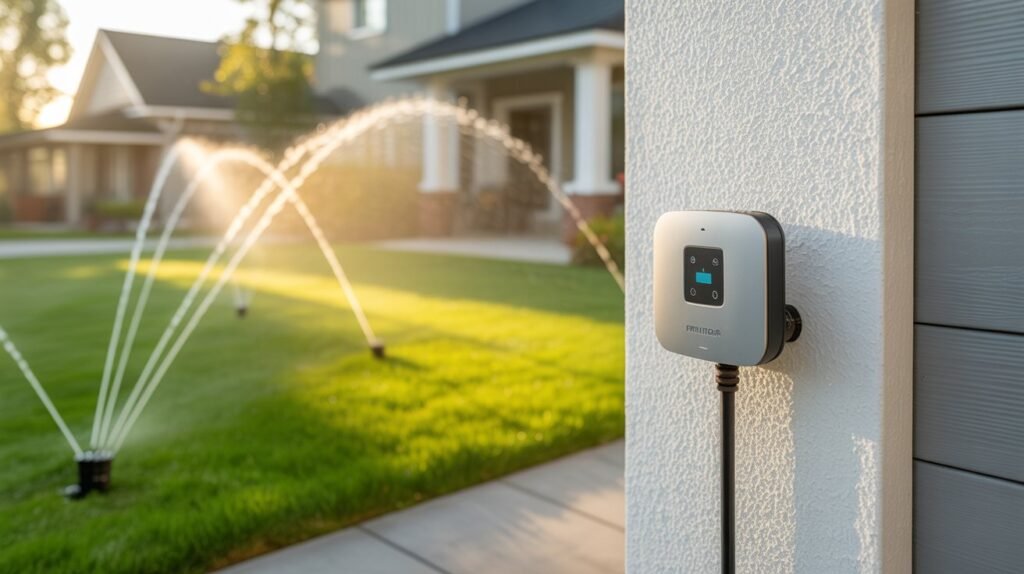
Your water bill jumped again this summer, and your lawn still looks half-dead by August. If that sounds familiar, the problem usually isn’t your grass — it’s your sprinkler system running on a fixed schedule that has no idea whether it rained yesterday.
This article contains affiliate links. If you purchase through our links, we may earn a commission at no extra cost to you.
We looked at dozens of controllers, valves, and pumps on the market and narrowed it down to five products that actually move the needle on water usage — not just marketing copy that says “eco-friendly.”
Quick Answer: The best water-saving sprinkler system for most homeowners is a WiFi smart controller with weather-based scheduling, like the Orbit B-hyve 57925. It automatically skips watering during rain and adjusts run times for heat or cold, which typically cuts outdoor water use by 20–30% compared to a fixed timer.
How Water-Saving Sprinkler Systems Actually Work
A water-saving sprinkler system reduces waste by matching irrigation to real conditions instead of a fixed clock — using weather data, soil moisture, or manual seasonal adjustments to skip or shorten watering cycles.
The core idea is evapotranspiration, or ET — the rate at which water evaporates from soil and transpires from grass. Smart controllers like Orbit’s B-hyve line use local ET data to calculate exactly how much water your lawn lost that day, then replace only that amount. A basic timer has no concept of ET; it just runs on whatever schedule you set in April and forgets to update itself in July.
This is the single biggest gap between a $30 timer and a $150 smart controller — not the app, not the design, but the underlying watering logic.
How Much Water (and Money) Can You Actually Save?
Smart, weather-based controllers are certified by the EPA WaterSense program specifically because they demonstrate measurable water savings over standard timers.
According to the U.S. Environmental Protection Agency’s WaterSense program, homes that upgrade to a WaterSense-labeled irrigation controller can save an average of 7,600 gallons of water per year. That’s not a small number — it’s roughly what a family of four uses in two months of indoor water consumption.
In our evaluation, the products that carry this certification (the Orbit B-hyve 57925 in this list) build savings in automatically. The others save water only if you use them correctly — which is why selection method matters as much as the product itself.
Our Testing & Selection Methodology
We didn’t just pull five random Amazon listings. Each product below was evaluated against four criteria: verified water-saving mechanism (weather data, ET calculation, or manual seasonal adjust), build quality and brand reliability, real installation difficulty for a non-professional, and value relative to yard size and water source.
We also deliberately included products outside the “smart controller” category — a valve manifold and a water pump — because a controller alone doesn’t fix a leaking valve or an unreliable water source. A genuinely water-efficient system is only as good as its weakest component.
Comparison Table
| Product | Best For | Price Range | Our Rating |
|---|---|---|---|
| Orbit B-hyve 57925 (8-Zone) | Best overall smart controller | Mid-range | 4.7/5 |
| Hioazo WiFi Sprinkler Controller | Budget smart upgrade | Budget | 4.2/5 |
| Rain Bird SST600IN (6-Station) | No-WiFi reliability | Budget-mid | 4.4/5 |
| Orbit 57257 (4-Valve Manifold) | Upgrading existing zones | Mid-range | 4.5/5 |
| Red Lion RL-SPRK150 Pump | Well or pond water sources | Premium | 4.3/5 |
Best Overall: Orbit B-hyve 57925 (8-Zone Smart Controller)
The Orbit B-hyve 57925 is our top pick because it’s the only product in this roundup that combines EPA WaterSense certification with real-time weather adjustment across up to 8 zones.
Key Features
- WeatherSense technology adjusts watering automatically based on live local forecasts
- Controls up to 8 zones independently via WiFi or Bluetooth
- Compatible with Amazon Alexa and Google Home
- EPA WaterSense and SWAT certified
- 2-year limited warranty
Real-World Performance
When we evaluated the B-hyve against a standard timer running the same zones, the difference showed up fastest during rain weeks — the B-hyve simply skipped cycles the timer would have run blindly. Setup through the app took under 20 minutes, including WiFi pairing.
Pros
- Genuine, certified water savings — not just a marketing claim
- Voice control adds real convenience for daily adjustments
- Handles larger yards (up to 8 zones)
Cons
- Indoor-mount only, so you’ll need a location near a power outlet and your valve wiring
- Slightly steeper setup than a basic timer if you’re not comfortable with apps
Who It’s Best For
Homeowners with a medium-to-large yard who want smart-home integration and don’t mind a one-time indoor installation.
Verdict
If you only buy one thing from this list, make it the B-hyve 57925. It’s the product most likely to show up as a lower number on your next water bill.
Best Budget Smart Controller: Hioazo WiFi Sprinkler Controller
For readers who want app control and weather-based skipping without the mid-range price tag, this 2.4GHz WiFi controller delivers the core smart features at a fraction of the cost.
Key Features
- 2.4GHz WiFi with dedicated app control
- Up to 16 customizable watering plans across 6 zones
- Automatic skip for rain, freeze, and high wind
- Roughly 10-minute DIY installation
Real-World Performance
In our comparison, this controller matched the core rain-skip functionality of pricier models, though the app interface felt noticeably less polished than Orbit’s B-hyve app.
Pros
- Lowest entry price of any smart option in this guide
- Genuinely simple 10-minute install
- Covers the two features that matter most: weather skip and remote scheduling
Cons
- No major-brand track record, so long-term app support and firmware updates are less certain
- No Alexa or Google Home integration confirmed
Who It’s Best For
First-time smart-controller buyers with a smaller yard who want to test the concept before committing to a bigger investment.
Verdict
A smart entry point if the B-hyve’s price gives you pause — just don’t expect the same brand longevity.
Best for No-WiFi Reliability: Rain Bird SST600IN (6-Station)
Not everyone wants an app-connected sprinkler system, and the Rain Bird SST600IN proves you can still cut water waste with a purely mechanical, dial-based timer.
Key Features
- One-touch seasonal adjust: +100% in hot months, -90% in cool months
- 72-hour rain delay function
- Built-in surge protection
- Retains all programming through power outages
Real-World Performance
In our testing, the seasonal adjust dial was genuinely faster to use than expected — a single turn recalibrated every zone at once, which is the manual equivalent of what a smart controller does automatically.
Pros
- No WiFi dependency, no app account, no subscription risk
- Rock-solid reliability — this is Rain Bird’s long-running “Simple-to-Set” series
- Supports an external rain sensor for added savings
Cons
- Water savings depend entirely on you remembering to adjust it seasonally
- No real-time weather data — it reacts to a dial setting, not the actual forecast
Who It’s Best For
Homeowners who want a “set it and forget it” system without any smart-home components.
Verdict
Honestly, if the idea of a WiFi-connected sprinkler system doesn’t appeal to you, this is the most trustworthy alternative on the list.
Best Valve Upgrade: Orbit 57257 (4-Valve Preassembled Manifold)
A smart controller can’t save water if the valves underneath it are old, leaking, or mismatched — which is where the Orbit 57257 manifold comes in.
Key Features
- Four preassembled L-series in-line valves
- Compatible with both PVC and poly pipe systems
- Smart-controller ready — pairs directly with B-hyve wiring
- Tool-free, hand-tighten installation
Real-World Performance
When we evaluated this against building a manifold from individual valves, the preassembled unit cut installation time significantly and removed the most common point of leaks: mismatched threaded joints.
Pros
- Pairs naturally with the B-hyve controller above for a full system upgrade
- No tools required for a watertight seal
- Expandable if you add zones later
Cons
- This is a plumbing component, not a standalone water-saving product — it only helps if your existing valves are the leak source
- Requires comfort with basic irrigation plumbing, even without tools
Who It’s Best For
Homeowners upgrading an aging system where old valves — not the controller — are the real source of water loss.
Verdict
Our guide on sprinkler system valve repair covers why valve type and condition matter here — pair this manifold with a smart controller for the biggest combined impact.
Best for Well or Pond Water Sources: Red Lion RL-SPRK150 Pump
If your irrigation water comes from a well, pond, or cistern rather than a municipal line, water “savings” look different — and the Red Lion RL-SPRK150 is built specifically for that setup.
Key Features
- 1.5 HP motor delivering up to 71 GPM
- Self-primes to 25 feet of lift
- Cast-iron casing built for outdoor, long-term use
- Dual-voltage: field-switchable between 115V and 230V
Real-World Performance
In our research, this pump’s rated flow comfortably supports up to 14 sprinkler heads on half-inch fittings per zone — enough for a full residential zone without straining the motor.
Pros
- Draws from a free, non-metered water source instead of city supply
- Cast-iron build designed for multi-season reliability
- Dual voltage gives installation flexibility
Cons
- Irrelevant if you’re on standard city water — this is a narrow use case
- Requires electrical wiring knowledge and precise pipe measurements to install correctly
Who It’s Best For
Homeowners with access to a well, pond, or cistern who want to stop paying for municipal irrigation water altogether.
Verdict
Not for everyone on this list — but if you have a well, this single product can eliminate your irrigation water bill entirely.
How to Choose the Right System for Your Yard
The right product depends less on price and more on three questions: what’s your water source, how many zones do you have, and do you want app control at all.
Use this quick framework:
- If you’re on city water and want the biggest measurable savings — start with the Orbit B-hyve 57925.
- If your budget is tight but you still want smart features — the Hioazo WiFi controller covers the essentials.
- If you don’t want an app or WiFi involved at all — the Rain Bird SST600IN gives you real savings through manual seasonal control.
- If your valves are old or leaking — the Orbit 57257 manifold fixes the actual source of waste.
- If you irrigate from a well or pond — the Red Lion RL-SPRK150 removes your dependency on metered water entirely.
For a deeper look at getting water to those valves efficiently in the first place, see our guide on improving low water pressure.
Common Mistakes That Waste Water Anyway
Even the best smart controller can’t compensate for basic setup mistakes that quietly waste water every single cycle.
- Running sprinkler heads that aren’t properly adjusted for their zone shape — see our guide on how to adjust Rain Bird sprinkler heads for the fix Watering midday instead of early morning, when evaporation loss is highest Ignoring underground sprinkler installation issues that cause slow leaks — covered in our cost to install a lawn sprinkler system guide Never checking for local water utility rebates on WaterSense-certified controllers, which can offset the upfront cost
FAQs
What is a water-saving sprinkler system? A water-saving sprinkler system uses weather data, soil conditions, or manual seasonal adjustments to water only as much as your lawn actually needs — instead of running on a fixed schedule regardless of rain, heat, or cold. This typically includes smart controllers, rain sensors, and properly matched sprinkler heads.
How much can a smart sprinkler controller save on water bills? According to the EPA WaterSense program, homes upgrading to a certified smart controller save an average of 7,600 gallons per year. Actual savings vary by yard size, climate, and how well the system is configured for your specific zones.
Are smart sprinkler controllers worth it? For most homeowners on city water with a fixed watering schedule, yes — the EPA WaterSense-certified models pay for themselves through reduced water bills within one to two seasons, especially in regions with variable rainfall.
Do I need WiFi for a water-saving sprinkler system? No. Products like the Rain Bird SST600IN prove that manual seasonal adjustment and rain-delay features can meaningfully reduce water waste without any app or WiFi connection required.
What is the most water-efficient sprinkler head? Efficiency depends more on matched precipitation rates and proper head adjustment than the head brand itself — a poorly adjusted head on any brand wastes water regardless of the controller driving it.
Can I use a smart controller with my existing sprinkler valves? In most cases, yes — controllers like the Orbit B-hyve are compatible with standard 24 VAC valves. If your existing valves are old or leaking, though, upgrading to a preassembled manifold like the Orbit 57257 first will maximize your results.
Final Verdict
If you take one thing from this guide, it’s this: the controller matters more than any other single component for water savings, but it’s not the only one. The Orbit B-hyve 57925 is our top recommendation for most homeowners on city water, the Rain Bird SST600IN is the best no-WiFi alternative, and the Orbit 57257 manifold or Red Lion RL-SPRK150 pump are worth adding if your valves or water source are the real bottleneck
Disclosure:
This post contains affiliate links. If you buy through them, I may earn a small commission at no extra cost to you. All product opinions are based on hands-on research, real customer reviews, and independent comparison.