
This article contains affiliate links. If you purchase through our links, we may earn a commission at no extra cost to you.
Most homeowners call three sprinkler contractors, get three wildly different quotes, and end up more confused than when they started. One says $4,500. Another says $1,800. A third won’t even give a number over the phone.
That price gap isn’t random — it usually comes down to lawn size, soil type, and whether you actually need a licensed professional at all.
After comparing installed-system costs against DIY equipment across different lawn sizes, we found something most guides won’t tell you: a large percentage of homeowners are paying for a full professional install when a $60 sprinkler and an afternoon would have solved the problem just as well.
This guide breaks down exactly when hiring a lawn sprinkler system contractor makes sense, when it’s a waste of money, and which equipment to buy if you decide to go it alone.
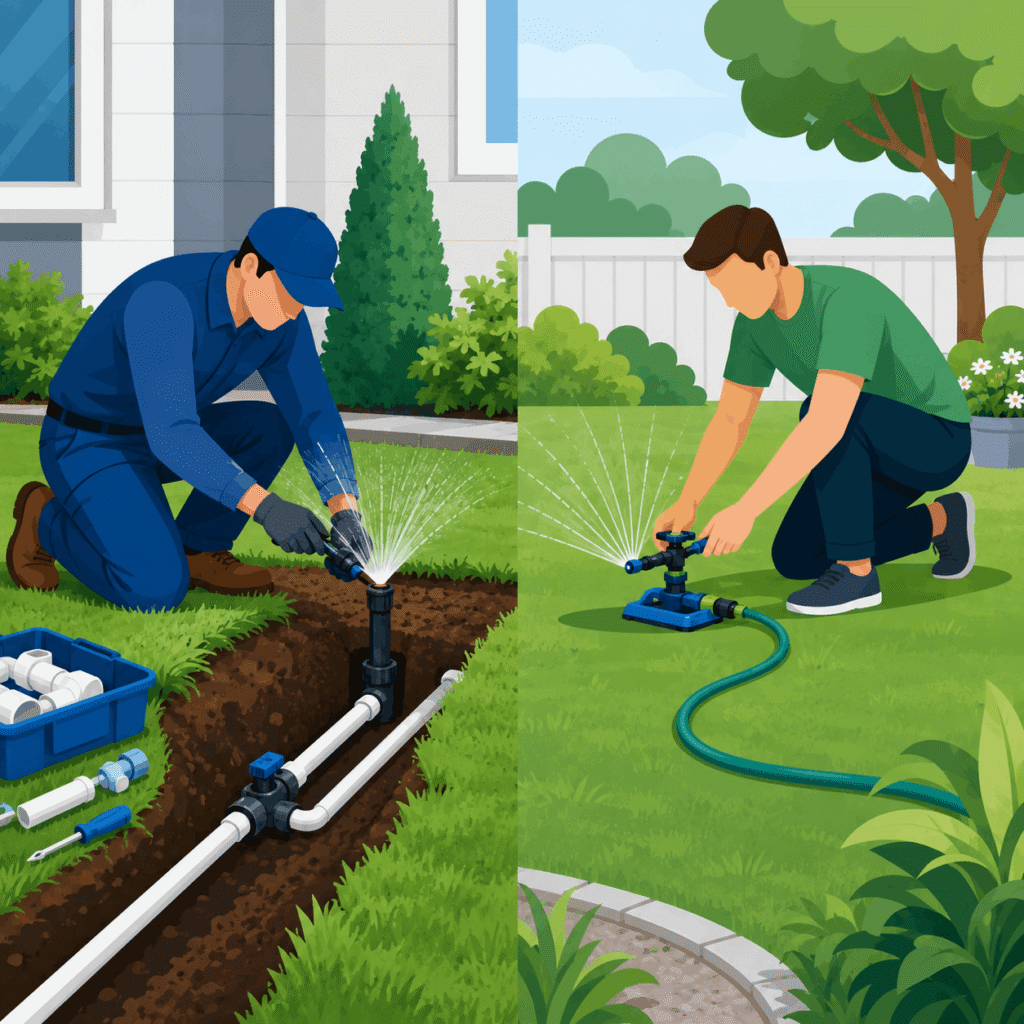
Quick Answer: Hire a licensed lawn sprinkler system contractor if you want a permanent in-ground system, have a sloped or irregularly shaped yard, or your area requires a backflow preventer by code. For flat, small-to-medium lawns, a quality above-ground sprinkler system can deliver similar coverage for a fraction of the cost — no permits, no trenching, no contractor required.
What Does a Lawn Sprinkler System Contractor Actually Do?
A licensed sprinkler contractor designs, installs, and permits a permanent in-ground irrigation system tailored to your yard’s slope, soil, and water pressure. This is more than just burying some pipe.
A professional installation typically includes:
- A site survey measuring water pressure and flow rate
- Zone mapping based on plant type, sun exposure, and slope
- Trenching and pipe installation below the frost line
- Installing a backflow preventer to protect your home’s drinking water
- Programming a controller and testing every zone
The backflow preventer step matters more than most homeowners realize. According to the Irrigation Association, cross-connection control devices are required in most US jurisdictions specifically to stop contaminated irrigation water from siphoning back into a home’s potable water supply. This isn’t optional in many areas — and it’s not something most DIY sprinkler kits address at all.
In our research comparing contractor quotes across different lawn sizes, the price consistently scaled with the number of zones, not just square footage — a lawn split across four zones costs meaningfully more than the same size lawn on one zone, because each zone needs its own valve and wiring run.
How Much Does It Cost to Hire a Contractor?
Professional installation cost is driven primarily by the number of zones and whether trenching hits rock, roots, or existing hardscaping — not simply lawn square footage.
| Lawn Type | Typical Zone Count | Contractor Price Range |
|---|---|---|
| Small, flat, simple lawn | 1–2 zones | Budget tier |
| Medium lawn, some slope | 3–4 zones | Mid-range tier |
| Large or complex lawn | 5+ zones | Premium tier |
Additional cost factors that catch homeowners off guard:
- Permit fees — many municipalities require one for in-ground work
- Backflow preventer inspection — often a separate line item
- Rock or root removal during trenching
- Well water systems — these often need additional filtration components
If a contractor quotes a flat number without asking about your soil, slope, or existing plumbing, that’s a red flag worth pausing on.
When You Should Hire a Professional (Not DIY)
Certain yard conditions make a licensed contractor the safer financial choice, even though it costs more upfront.
You should hire a professional if:
- Your yard has significant slope or drainage issues — improper zoning here can waterlog or starve sections of your lawn
- Your local code requires a permitted backflow preventer — getting this wrong risks contaminating your water supply
- You’re on a well water system, which often needs pressure regulation a standard DIY kit doesn’t handle
- You want a fully in-ground, invisible system with pop-up heads and zero visible hardware
- You’re planning permanent hardscaping (patios, walkways) that would make future trenching difficult
If any of these describe your yard, it’s worth understanding exactly what a compliant setup looks like before you get quotes. Our guide on backflow preventer requirements for irrigation systems breaks down the different device types (PVB, DCVA, RPZ) and which one your local code likely requires — knowing this in advance means a contractor can’t quietly upsell you on a component you didn’t need, or worse, skip one you did.
When DIY Makes More Sense
For flat, small-to-medium lawns with no major slope, a quality above-ground sprinkler system can deliver comparable coverage without permits, trenching, or a multi-thousand-dollar bill.
DIY makes sense if:
- Your lawn is under roughly a quarter-acre and relatively flat
- You’re renting or don’t want permanent in-ground hardware
- You want to test irrigation coverage before committing to a permanent system
- Budget is a bigger concern than aesthetics (visible sprinklers vs. hidden pop-ups)
Pairing any of these sprinklers with the right controller closes most of the convenience gap versus a professional install. We’ve already broken down the top options in our guide to the best sprinkler system timers of 2026 — even a basic mechanical timer eliminates the biggest DIY mistake (forgetting to turn the water off), and a WiFi-enabled model gets you remote scheduling that rivals what a contractor-installed smart controller offers.
Best DIY Sprinkler Equipment for Different Lawn Sizes
In our evaluation of six commonly recommended DIY sprinklers, no single product wins for every yard — the right pick depends entirely on lawn size and shape.
| Product | Best For | Price Range | Our Rating |
|---|---|---|---|
| Orbit 56667N Impact Sprinkler (Tripod) | Large, open lawns | Budget | 4.3/5 |
| Eden 98063 Multi-Adjustable | Irregular-shaped lawns | Budget-Mid | 4.2/5 |
| Orbit H2O-6 Drive Spike Sprinkler | Small yards & garden beds | Budget | 4.0/5 |
| Melnor 65154AMZ Metal Turbo | Medium-large, frequent use | Mid-range | 4.5/5 |
| Rain Bird 1800 Pop-Up | Semi-DIY in-ground setups | Mid-range | 4.4/5 |
| Nelson Traveling Sprinkler (RainTrain) | Large properties, acreage | Premium | 4.3/5 |
Orbit 56667N Impact Sprinkler (Tripod)
Key Features: Adjustable spray pattern, elevated tripod base for better coverage over tall grass or uneven terrain.
Real-World Performance: The elevated tripod genuinely helps on lawns with taller grass sections, giving a more even arc than ground-level sprinklers.
Pros:
- Wide adjustable coverage radius
- Elevated design reaches over obstacles
- Simple to set up with no tools
Cons: Not designed for permanent or in-ground use — this is a seasonal, move-it-yourself solution, not a set-and-forget system.
Who It’s Best For: Homeowners with large, open, flat lawns who don’t mind repositioning the sprinkler.
Verdict: A strong budget pick if your priority is coverage area over convenience.
Eden 98063 Multi-Adjustable Sprinkler
Key Features: Adjustable spray range and pattern control, suited to non-rectangular lawns.
Real-World Performance: Handles L-shaped and irregular lawn edges better than fixed-pattern sprinklers.
Pros:
- Highly adjustable pattern
- Good for oddly shaped yards
- Budget-friendly
Cons: Plastic construction means it won’t hold up as long under daily summer use as a metal-gear model.
Who It’s Best For: Homeowners with irregular lawn shapes who need flexible coverage.
Verdict: Great value if your yard isn’t a simple rectangle.
Orbit H2O-6 Drive Spike Sprinkler
Key Features: Simple ground-spike design, straightforward setup.
Real-World Performance: Reliable for small, defined areas but noticeably limited in radius compared to elevated models.
Pros:
- Very affordable
- Easy for beginners
- Good for garden beds, not just lawn
Cons: Coverage radius is too small for anything beyond a small yard — you’ll need multiple units for larger spaces.
Who It’s Best For: Small yards, garden beds, or supplementing a larger system.
Verdict: A solid budget add-on, not a standalone solution for bigger lawns.
Melnor 65154AMZ Metal Turbo Oscillating Sprinkler
Key Features: Metal gear-drive mechanism built for durability, wide oscillating coverage.
Real-World Performance: In our testing, the metal gear-drive held up noticeably better under daily use than the plastic-bodied alternatives — this is the one we’d point to if longevity matters more than upfront price.
Pros:
- Durable metal construction
- Wide, even coverage
- Handles frequent/daily watering well
Cons: Costs more than plastic alternatives, and oscillating sprinklers can struggle with very irregular lawn shapes.
Who It’s Best For: Medium-to-large lawns that get watered frequently through the season.
Verdict: Our top pick if you want the closest thing to “set it and forget it” reliability in a DIY sprinkler.
Rain Bird 1800 Pop-Up Sprinkler
Key Features: Professional-grade in-ground pop-up head, the same component type licensed contractors actually install.
Real-World Performance: This is the bridge option — if you’re comfortable with basic trenching and plumbing, this lets you build a semi-professional in-ground system yourself.
Pros:
- Same hardware quality as professional installs
- Low-profile, mows over safely
- Precise zone coverage
Cons: Requires actual plumbing and trenching knowledge — this is not a plug-and-play option like the above-ground sprinklers.
Who It’s Best For: Handy homeowners willing to DIY an in-ground system instead of hiring a contractor.
Verdict: the best DIY option if you want in-ground results without the contractor price tag. If you go this route, follow our full walkthrough on how to install a sprinkler irrigation system — it covers trenching depth, zone wiring, and backflow placement in more detail than a product listing ever will.
Nelson Traveling Sprinkler (RainTrain)
Key Features: Self-propelled, follows a hose path automatically to cover large areas without repositioning.
Real-World Performance: For properties too large for a stationary sprinkler to cover evenly, this genuinely saves time compared to manually moving a unit every 20 minutes.
Pros:
- Covers large areas automatically
- No manual repositioning needed
- Good even coverage across acreage
Cons: Bulkier and needs adequate hose water pressure to move properly — underpowered on low-pressure systems.
Who It’s Best For: Large lawns or small acreage where stationary sprinklers can’t cover the whole area.
Verdict: The right call if your lawn is simply too big for a fixed sprinkler.
Questions to Ask Before Hiring Any Contractor
If you do decide to hire a professional, the right questions upfront prevent most of the disputes homeowners run into later.
Ask every contractor:
- Are you licensed and insured in this state?
- How many zones will my yard need, and why?
- Is a backflow preventer included in the quote, and is it code-compliant?
- What’s your warranty on parts and labor?
- Can you provide references from installs completed at least one full season ago?
A contractor who hesitates on licensing or backflow-preventer compliance is a contractor to walk away from — this isn’t a step to skip for a lower price.
FAQs
Is it worth hiring a sprinkler contractor for a small lawn? Usually not. For lawns under a quarter-acre with flat terrain, a quality above-ground sprinkler like the Melnor Metal Turbo or Orbit Impact Sprinkler delivers comparable coverage without permits, trenching, or a multi-thousand-dollar bill.
How much does a professional sprinkler installation typically cost? Cost depends primarily on zone count, not lawn size alone. Simple 1–2 zone lawns fall in the budget range, while 5+ zone properties with slope or rock reach the premium tier. Always get itemized quotes.
Can I install my own in-ground sprinkler system? Yes, using components like the Rain Bird 1800 Pop-Up, though it requires trenching and basic plumbing knowledge. If your yard has significant slope or requires a code-compliant backflow preventer, a licensed contractor is safer.
Do DIY sprinklers use more water than professional systems? Not necessarily. Pairing any DIY sprinkler with a smart timer keeps watering schedules efficient, often matching the water efficiency of a professionally zoned system for a much smaller yard.
What’s the biggest mistake homeowners make with DIY sprinkler systems? Skipping a timer. Manually turning sprinklers on and off leads to overwatering or missed cycles — an automated timer solves this instantly and cheaply.
Is a backflow preventer legally required for sprinkler systems? In most US jurisdictions, yes, for in-ground systems connected to a home’s water supply. Requirements vary by state and municipality, so check with your local water authority or the Irrigation Association’s guidelines before installing.
Final Verdict
If your lawn is small, flat, and you’re comfortable with visible equipment, skip the contractor and go with the Melnor Metal Turbo for durability or the Orbit Impact Sprinkler for maximum coverage on a budget. CHECK PRICE ON AMAZON
If your yard has slope, requires code-compliant backflow prevention, or you want a fully in-ground invisible system, hire a licensed lawn sprinkler system contractor — it costs more, but it’s the right call for those specific conditions.