
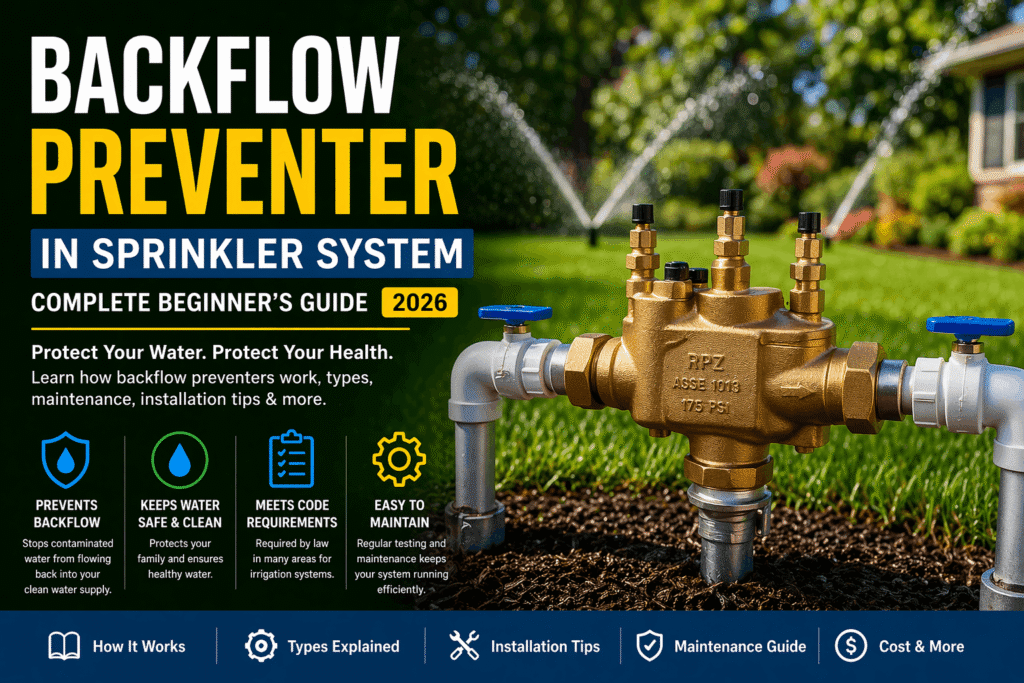
A single pressure drop in your street’s water main is all it takes for fertilizer-laced runoff sitting in your sprinkler lines to get pulled backward into your drinking water — and most homeowners never know it happened.
Quick Answer: A backflow preventer in a sprinkler system is a mechanical valve assembly that blocks contaminated irrigation water from reversing into your home’s potable water supply. The main types are AVB, PVB, DCV, and RPZ — the right one depends on your local code, your system’s pressure, and whether chemicals like fertilizer injectors are present.
What Is a Backflow Preventer in Sprinkler System?
A backflow preventer is a one-way valve assembly, not a single simple part — it’s the device standing between your lawn’s irrigation water and your kitchen tap.
Water is supposed to flow one direction only: from the municipal supply, through your sprinkler heads, onto your lawn. Two conditions can reverse that flow. Back-siphonage happens when pressure upstream drops suddenly — a water main break or a fire hydrant in use nearby. Back-pressure happens when downstream pressure (from a pump or elevated tank) pushes water backward instead.
Either condition can pull soil bacteria, fertilizer, or pesticide residue from your irrigation line straight into the pipes that feed your household water.
Why a Backflow Preventer Matters More Than Most Homeowners Realize
The financial and health cost of a failed backflow event is far higher than most people assume. According to the EPA, a typical backflow contamination incident takes close to 500 hours to resolve and can cost thousands of dollars in cleanup and remediation — numbers most homeowners never see coming until it happens to their own water system.
Irrigation systems specifically sit on the EPA’s list of the highest-risk cross-connection categories in residential plumbing, right alongside boilers and cooling towers. That’s because sprinkler lines routinely carry standing water mixed with soil, fertilizer, and lawn chemicals — exactly the kind of contamination a cross-connection can pull into a home’s supply.
Beyond health risk, most municipalities legally require a backflow prevention assembly on any in-ground irrigation system tied to the public water supply. Skipping one isn’t just risky — in many jurisdictions, it’s a code violation.
How Does a Backflow Preventer Work?
Every backflow preventer works the same basic way: it lets water flow forward and mechanically blocks it from reversing. The exact mechanism depends on the assembly type, but all of them rely on some combination of check valves, air gaps, or pressure-differential relief ports.
Under normal operation, water passes through the device without resistance. The moment the device detects reverse pressure — whether from back-siphonage or back-pressure — an internal valve closes or an air-gap vent opens, physically severing the connection between the irrigation line and the potable supply.
This response happens automatically, with no homeowner intervention required, which is exactly why a functioning device is non-negotiable for code compliance.
Types of Backflow Preventers for Sprinkler Systems
Four backflow preventer types cover almost every residential irrigation setup, and each one is built for a different level of contamination risk.
1. Atmospheric Vacuum Breaker (AVB)
- Mounted above ground, directly downstream of the last shutoff valve
- Uses a simple air-inlet mechanism rather than continuous pressure monitoring
- Best for: basic residential systems with no continuous pressure and no chemical injection
Pros: Inexpensive, straightforward installation. Cons: Cannot be used under constant pressure — it must be located downstream of the control valve, which limits placement options.
2. Pressure Vacuum Breaker (PVB)
Per ASSE 1020 standards, a PVB assembly must sit outside, at least one foot above the highest sprinkler head, and no more than five feet above grade.
- Works reliably even under continuous system pressure
- The most common assembly on residential in-ground systems
Pros: Handles constant pressure; flexible placement compared to an AVB. Cons: Strict height requirements make retrofit installations trickier on sloped yards.
3. Double Check Valve Assembly (DCV)
Industry guidance from AWWA M-14 (the American Water Works Association’s cross-connection control standard) recommends a DCV on wet or dry sprinkler systems unless a high-hazard cross-connection is present.
- Uses two independent check valves in series
- Compact enough for tight installation spaces
Pros: Durable, low-profile design. Cons: Not rated for high-hazard contamination sources, such as systems with fertilizer or chemical injection.
4. Reduced Pressure Zone Assembly (RPZ)
- The highest protection level of any residential-grade device
- Required wherever a high-hazard cross-connection exists — chemical injectors, for example
Pros: Handles virtually any contamination risk, including chemically treated irrigation lines. Cons: Higher upfront cost and mandatory annual testing in most jurisdictions.
Where Is the Backflow Preventer Located?
Placement rules exist for a reason: a misplaced backflow preventer can fail exactly when it’s needed most.
Most residential assemblies sit near the water meter, just outside the house, ahead of the irrigation control valves. Devices like the PVB have strict height rules — installed too low, and the vacuum-breaking mechanism can’t function correctly during a pressure drop.
Key placement rules to check before installation:
- Confirm the device sits above the highest sprinkler head if your assembly type requires it (PVB, AVB).
- Keep the assembly accessible for annual testing and maintenance.
- Protect the unit from flooding — an RPZ assembly discharges water during operation and needs proper drainage.
Signs Your Backflow Preventer Is Failing
A failing backflow preventer rarely announces itself loudly — it shows up as small, easy-to-dismiss symptoms first.
- Water pooling or leaking around the device housing
- Unusual drop in sprinkler pressure across one or more zones — worth checking against our pressure regulator guide before assuming the preventer itself is at fault
- Discolored or cloudy water at household taps after running the sprinklers
- Hissing, vibrating, or clicking noises coming from the assembly
- Continuous water discharge from the relief valve even when the system is off
Any one of these signs is reason enough to schedule a professional inspection — not a wait-and-see approach.
How to Maintain a Backflow Preventer
Consistent maintenance is what keeps a backflow preventer compliant and functional for its full lifespan.
- Inspect the housing and valve seals for cracks or corrosion at the start of each season.
- Clear away dirt, mulch, or debris that’s accumulated around the device.
- Schedule annual testing — many jurisdictions legally require this for PVB, DCV, and RPZ assemblies.
- Drain the device fully before the first hard freeze to prevent internal cracking, and inspect again once temperatures rise in spring.
Do You Need a Professional for Installation?
AVB installation is realistically the only type most DIY-comfortable homeowners should attempt themselves.
PVB, DCV, and RPZ assemblies involve code-specific placement, pressure testing, and — in most areas — certification requirements that only a licensed backflow technician can satisfy. Getting this wrong doesn’t just risk a failed inspection; it risks the exact contamination the device exists to prevent.
Installation costs vary by assembly complexity: simpler devices typically fall in the lower end of residential plumbing costs, while RPZ assemblies with mandatory professional testing sit meaningfully higher. If you’re budgeting for a full system alongside this, our sprinkler system cost guide breaks down where a backflow assembly typically fits into total installation pricing.
Common Mistakes to Avoid
- Installing the wrong device type for your system’s pressure and contamination risk level
- Ignoring height and placement requirements, especially for PVB assemblies
- Skipping annual testing, even when your device seems to be working fine
- Delaying repairs after noticing leaks, noise, or pressure changes
- Overlooking local code requirements, which vary significantly by municipality
Regular upkeep of the rest of your irrigation system matters too — our guide on cleaning sprinkler heads covers the maintenance side that often gets neglected alongside backflow devices.
Frequently Asked Questions
What is a backflow preventer in a sprinkler system? It’s a mechanical valve assembly installed on an irrigation line that stops contaminated water from reversing into a home’s clean water supply. The device activates automatically during pressure changes, without any action needed from the homeowner.
Is a backflow preventer required by law for sprinkler systems? Yes, most municipalities require a backflow prevention assembly on any in-ground irrigation system connected to the public water supply. Requirements and approved device types vary by local code, so checking with your municipal water authority is the safest first step.
How often should a backflow preventer be tested? Testable assemblies — PVB, DCV, and RPZ — generally require annual testing by a certified technician in most jurisdictions. Skipping testing can result in code violations even if the device appears to be functioning normally.
Can I install a backflow preventer myself? A basic AVB is realistic for homeowners comfortable with plumbing work, but PVB, DCV, and RPZ assemblies typically require professional installation to meet height, pressure, and certification requirements.
What happens if a sprinkler system doesn’t have a backflow preventer? Without one, pressure changes in the water main can pull fertilizer, pesticide residue, or soil bacteria from the irrigation line directly into the home’s drinking water. This is precisely the contamination risk the EPA lists irrigation systems as a high-risk source for.
How long does a backflow preventer last? Most residential assemblies last between 5 and 15 years, depending on device quality, water conditions, and how consistently the required maintenance and testing schedule is followed.
What’s the difference between a DCV and an RPZ assembly? A DCV uses two check valves and suits most standard residential systems, while an RPZ adds a pressure-relief mechanism and is required wherever a high-hazard cross-connection exists, such as systems with fertilizer injectors.
Final Verdict
A backflow preventer in a sprinkler system isn’t an optional upgrade — it’s the one component standing between your lawn’s irrigation water and the water your household drinks. For most standard residential systems, a PVB or DCV assembly satisfies local code; systems with chemical injectors need the added protection of an RPZ.
Whichever type applies to your setup, the real risk isn’t choosing the wrong device — it’s skipping annual testing and letting a failing assembly go unnoticed.
META DATA (DO NOT PUBLISH)
SEO Title: Backflow Preventer in Sprinkler System: Types & Guide (2026) Meta Description: Learn how a backflow preventer in a sprinkler system works, the 4 main types (AVB, PVB, DCV, RPZ), and how to spot a failing one before it costs you. URL Slug: backflow-preventer-in-sprinkler-system Primary Keyword: backflow preventer in sprinkler system Secondary Keywords: types of backflow preventers, PVB vs RPZ sprinkler, backflow preventer sprinkler system requirements, how does a backflow preventer work, backflow preventer maintenance, sprinkler system cross connection Schema Type: Article + FAQPage Image Alt Text Suggestions:
- “Backflow preventer installed on sprinkler system water line”
- “Types of backflow preventers for sprinkler systems diagram”
- “PVB backflow preventer assembly outside home”
Internal Links Placed:
- “pressure regulator guide” → https://hydrosprinkler.com/pressure-regulator-for-sprinkler-system-3/
- “sprinkler system cost guide” → https://hydrosprinkler.com/how-much-does-a-sprinkler-system-cost/
- “cleaning sprinkler heads” → https://hydrosprinkler.com/how-to-clean-sprinkler-heads/
External Links Placed:
- EPA cross-connection risk data → https://www.epa.gov/
- AWWA M-14 standard reference → American Water Works Association (official)
- ASSE 1020 standard reference → ASSE International (official)
Note on the old version: the previous live article linked out to usa.water-leakage-summit.com, which is not a real regulatory or industry authority site — that kind of low-quality/unrelated external link can hurt E-E-A-T signals and may be part of why this page wasn’t indexing well. This rewrite removes it and replaces it with EPA, AWWA, and ASSE references only.