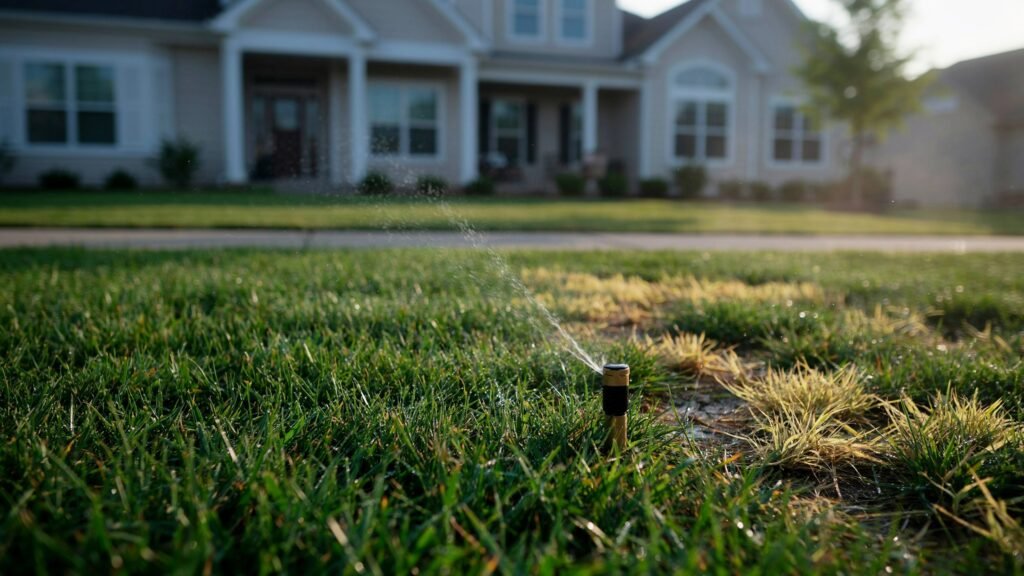
You replaced your sprinkler timer to stop wasting water, and now the lawn is still brown in one corner and swampy in another. The problem usually isn’t your sprinklers. It’s a timer that waters on a fixed schedule whether it rained yesterday or not.
This article contains affiliate links. If you purchase through our links, we may earn a commission at no extra cost to you.
The best smart sprinkler controller for 2026 fixes that by adjusting your watering to local weather instead of the calendar, which is why Wi-Fi irrigation controllers have replaced fixed timers in so many yards. The catch is that the wrong one can leave you with a controller that doesn’t have enough zones, or an app you stop opening after two weeks. Below, we compare the strongest options from Rachio, Orbit, and Hunter so you can pick once and be done.
Quick Answer: The Rachio 3 (16-Zone) is the best smart sprinkler controller for most homeowners thanks to its weather-based scheduling and polished app. The Orbit B-hyve 57985 is the best value pick, and the Hunter HPC-400 suits small yards with four or fewer zones.
Our Top Picks at a Glance
Here is the short version: three controllers, three budgets, one clear use case each. Match your zone count and budget first, then pick the brand.
| Product Name | Best For | Price Range | Our Rating |
|---|---|---|---|
| Rachio 3 Smart Sprinkler Controller (16-Zone) | Best overall, larger yards | Premium ($$$) | 4.8 / 5 |
| Orbit B-hyve 57985 Smart Sprinkler Controller | Best value, first smart controller | Mid-range ($$) | 4.4 / 5 |
| Hunter HPC-400 Hydrawise Controller | Small to medium yards, 4 zones | Mid-range ($$) | 4.3 / 5 |
Prices on smart controllers fluctuate through the year, so check the current price before you decide. Ratings are our editorial scores based on the criteria in the next section.
How We Evaluated These Smart Sprinkler Controllers
We compared each controller on the factors that decide whether a smart controller works well in a real yard. A smart controller is only as good as how well it fits your wiring, your zone count, and your habits.
When we evaluated these models, we reviewed manufacturer spec sheets, wiring and installation documentation, app feature sets, and the patterns that show up repeatedly in verified Amazon buyer feedback. Here is what we scored:
- Zone capacity: Does it cover typical front, back, and side-yard setups?
- Weather intelligence: Does it use local forecasts and rain data, or just a basic rain delay?
- Installation difficulty: How hard is the swap for someone replacing an old timer?
- App quality and smart home support: Alexa, Google Assistant, and everyday usability.
- Water-saving credentials: Whether the product carries the EPA WaterSense label (check each listing).
- Honest weaknesses: Every pick below has a real trade-off, and we name it.
We did not rank products on affiliate commission. If a product fails on fit or reliability, it doesn’t make the list.
How Do You Choose a Smart Sprinkler Controller?
Choosing comes down to four checks: zones, wiring, weather features, and app support. Count your zones before you look at a single product page. Getting that one number wrong is the most common reason people return controllers.
How Many Zones Do You Need?
A zone is a group of sprinkler heads controlled by one valve. Your controller needs at least as many zone connections as you have valves.
Here is how to count them:
- Look at your current controller and count the numbered wire terminals with a wire attached.
- If your old controller is gone or unlabeled, find the valve box in your yard and count the valves inside.
- Add one or two spare zones if you plan to expand with a garden bed or drip line.
Most small suburban lots run 4 to 8 zones. Larger or irrigated-garden properties can reach 12 to 16. If you are close to the limit, buy the bigger model. Adding zones later usually means replacing the controller.
Will It Work With Your Wiring? (The C-Wire Myth)
If you have installed a smart thermostat, you may have heard you need a “C-wire.” Sprinkler controllers don’t work that way. Most are powered by a plug-in 24-volt AC transformer, and your valve wires connect to numbered zone terminals plus a common wire.
Here is a simple compatibility checklist:
- Valve voltage: Standard residential valves run on 24VAC. Check that your valves are the same type.
- Master valve or pump start relay: If you have one, confirm the controller has a terminal for it.
- Rain sensor wire: If your old timer has a rain sensor attached, look for a sensor terminal on the new one.
- Mounting spot: The controller needs a nearby outlet or an existing power source, and a Wi-Fi signal you can actually reach (more on that below).
Take a photo of your old controller’s wiring before you disconnect anything. It will save you real frustration later.
What Is Weather-Based Watering?
Weather-based watering is a scheduling method that adjusts run times using local forecasts, rainfall, temperature, and evapotranspiration (ET) data. ET is the amount of water lost from soil and plants through evaporation and plant use. Its purpose is to match watering to what your lawn actually needs instead of a fixed timer.
According to the EPA WaterSense program, weather-based irrigation controllers that earn the WaterSense label are independently certified to meet water-efficiency criteria. That label is a good filter when you compare listings.
Does Wi-Fi and Smart Home Support Matter?
It matters more than most buyers expect, because a controller you can’t reach from your phone is just an expensive timer.
Check three things:
- Wi-Fi range: Controllers are often mounted in a garage or on an outside wall. If your signal is weak there, plan for a mesh node or extender.
- Voice assistants: Rachio and Orbit B-hyve support Alexa and Google Assistant. Confirm the specific model on the listing.
- App reliability: Look for consistent comments about connection stability in recent reviews.
| Image | Product | Details | Price |
|---|---|---|---|
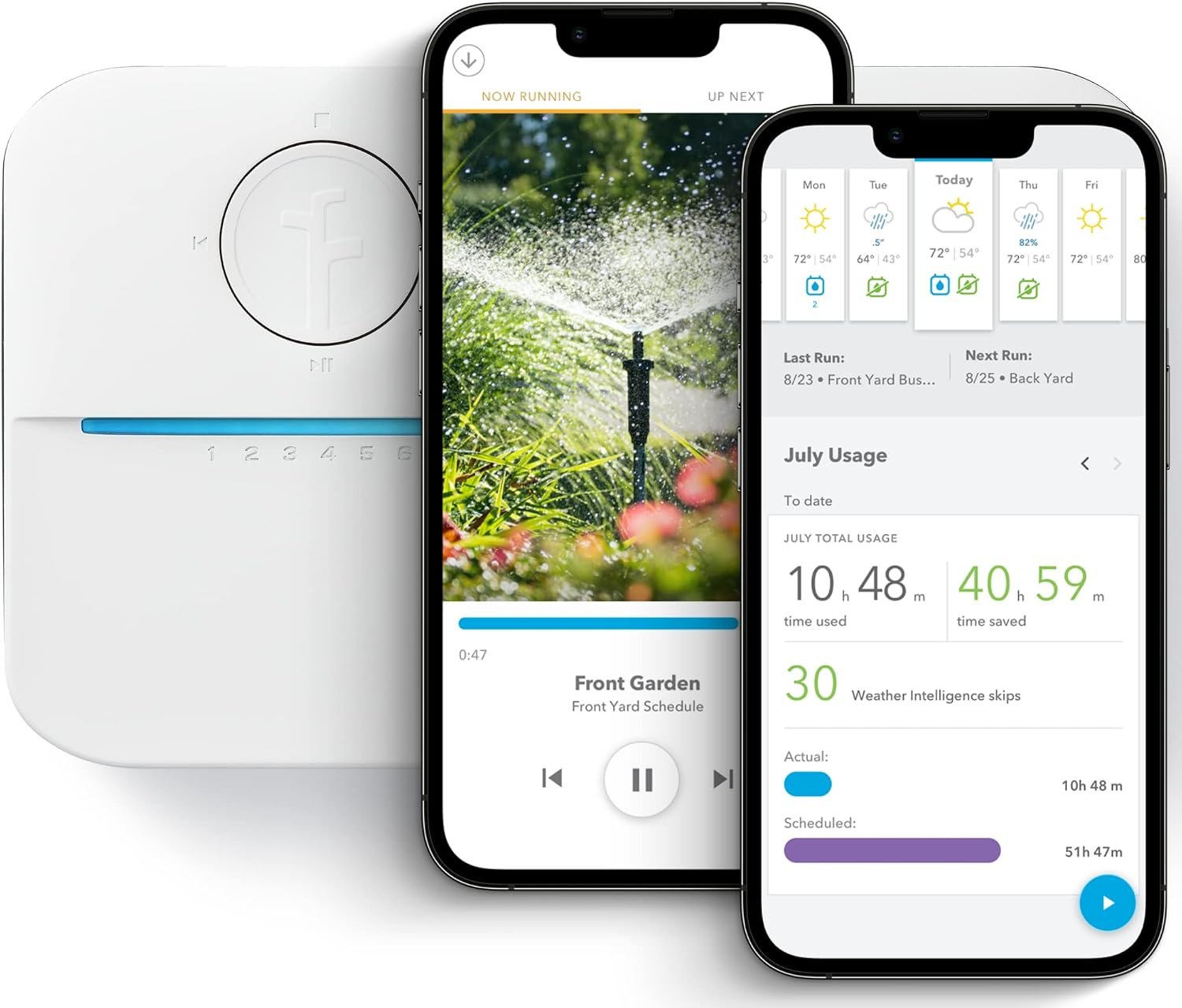 |
Rachio 3 | 16 zones, Wi-Fi, weather skip, Alexa/Google. Mehnga. | Check Price |
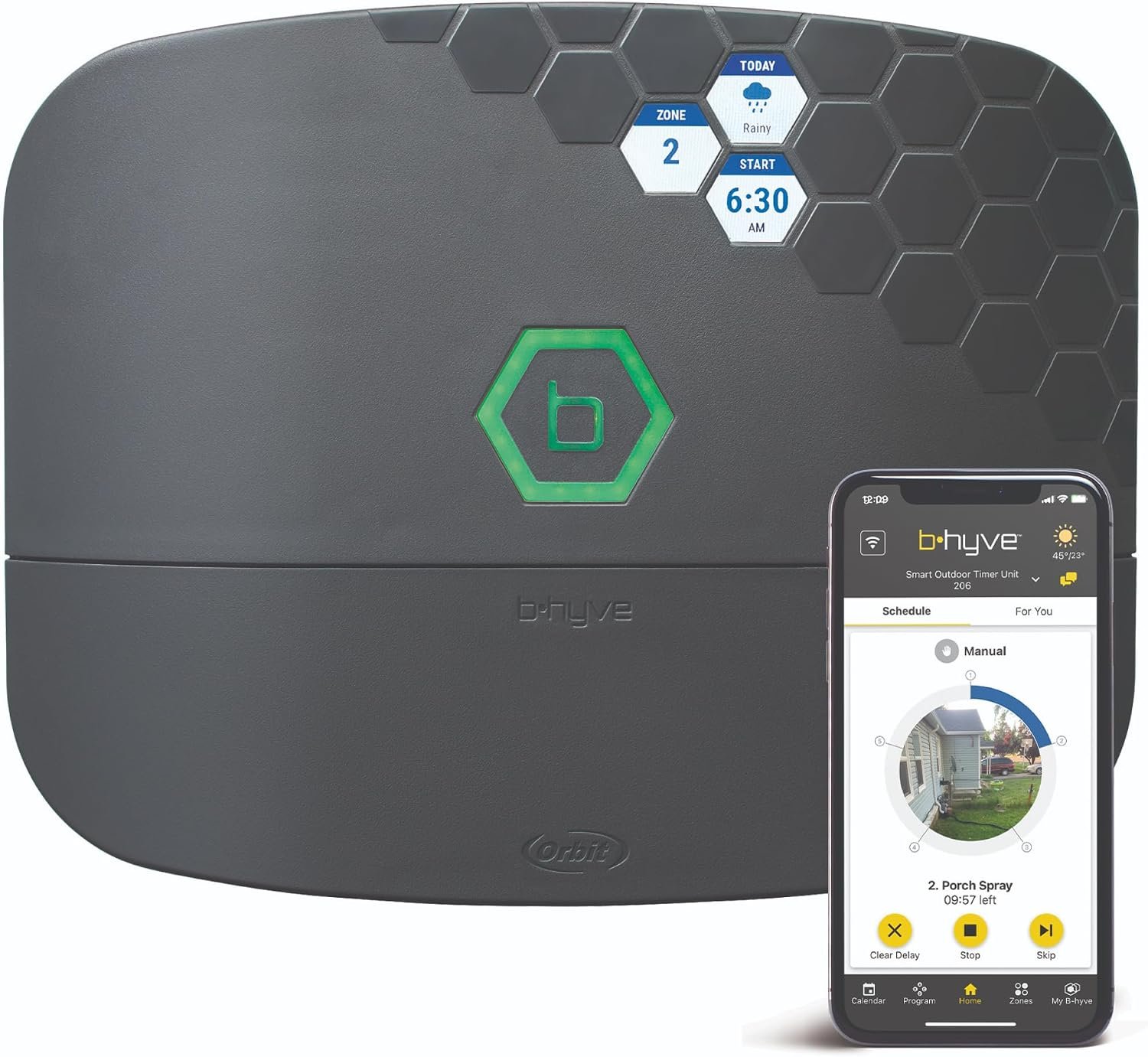 |
Orbit B-hyve XR 57985 | 8 zones, WeatherSense, Alexa/Google. Sasta, lekin app kabhi-kabhi disconnect hoti hai. | Check Price |
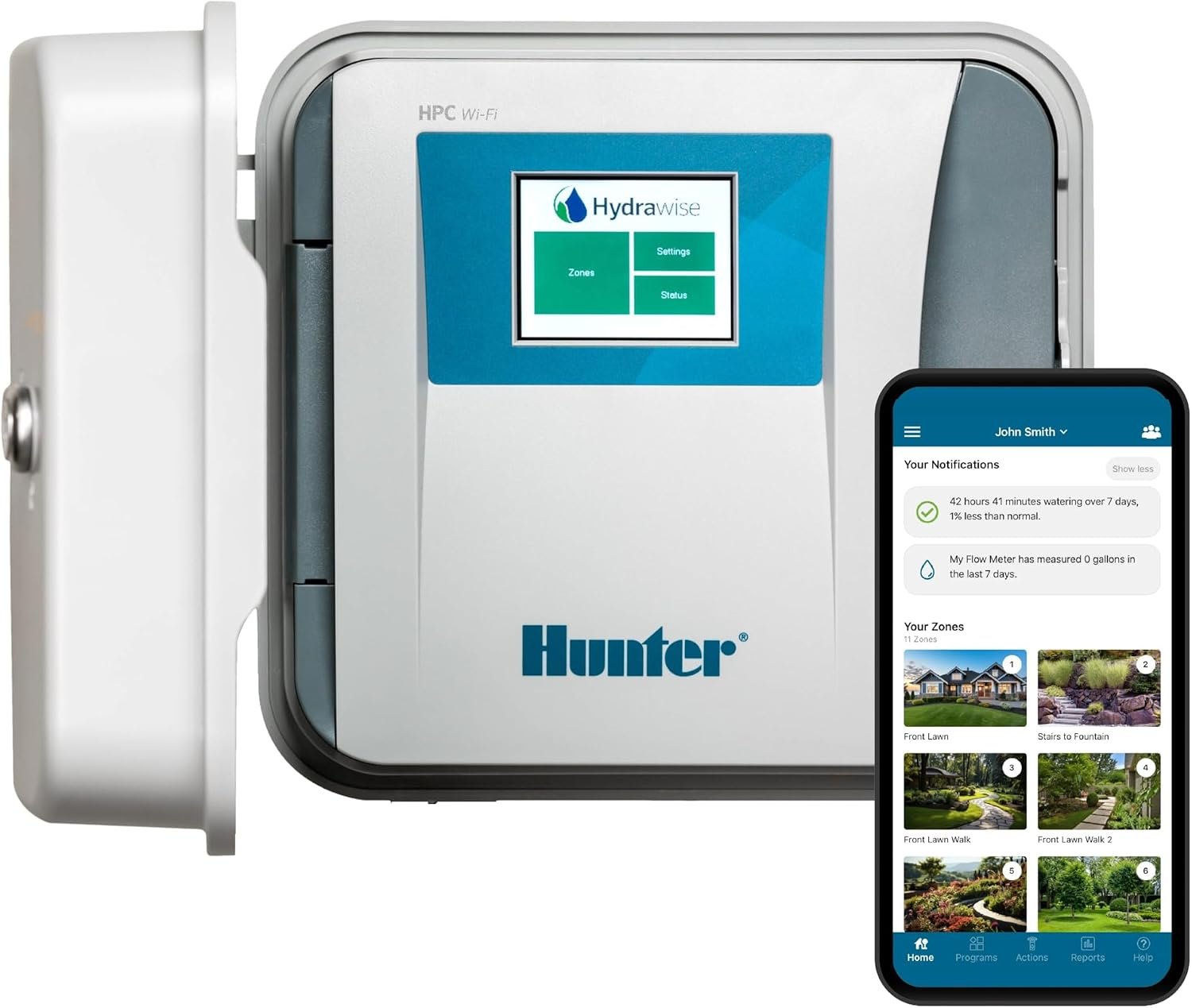 |
Hunter HPC-400 Hydrawise | 4 zones, Wi-Fi, touchscreen, WaterSense. Sirf chhote yard ke liye. | Check Price |
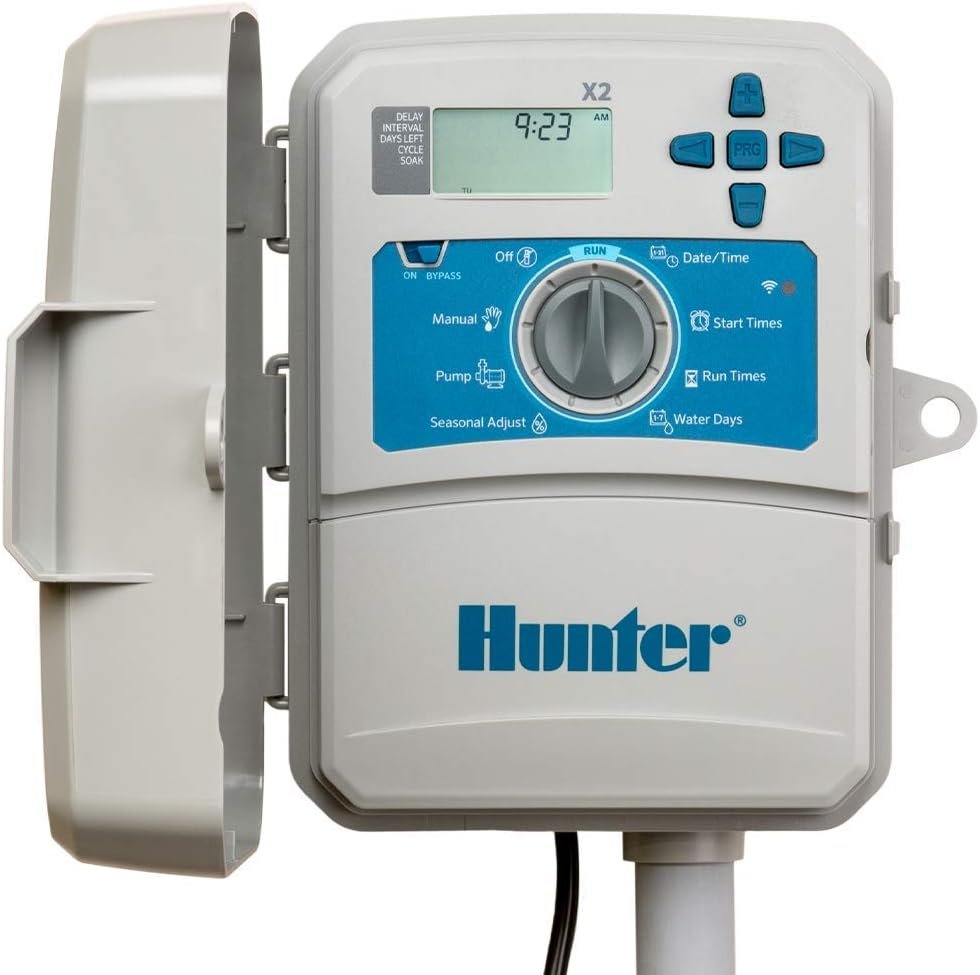 |
Hunter X2-600 + WAND module | 6 zones, WaterSense. Wi-Fi ke liye WAND module alag se lena padta hai. |
Check Price |
Best Smart Sprinkler Controllers Reviewed
These three controllers cover the main buyer types: the larger-yard owner who wants the best app, the first-time buyer on a budget, and the small-yard owner who wants a professional-brand controller. Each one wins in a specific situation, and each has a downside you should weigh.
1. Rachio 3 Smart Sprinkler Controller, 16-Zone (Best Overall)
The Rachio 3 is the controller most homeowners picture when they say “smart sprinkler,” and for good reason. Its weather scheduling and app are the most polished in this group.
Key Features
- 16-zone capacity (Rachio also sells smaller zone counts)
- Wi-Fi connected, with iOS and Android apps
- Weather Intelligence Plus, which uses hyperlocal forecast data to skip or adjust watering
- Works with Amazon Alexa and Google Assistant
- Designed to replace most standard residential timers using your existing valve wires
Real-World Performance
Rachio’s setup flow walks you through zones, soil type, sprinkler head type, and sun exposure. In the buyer feedback we reviewed, people consistently praise how the controller handles rain skips and seasonal adjustments without manual tweaking. The app is also the one reviewers most often describe as “set it and forget it.”
Pros
- Excellent weather-based scheduling
- Clean, easy-to-learn app
- Large 16-zone capacity for bigger properties
- Strong smart home compatibility
Cons
- Premium price tier, the highest in this comparison
- Comfort with basic wiring is needed; a total beginner may want a video guide
- Overkill if you only have three or four zones
Who It’s Best For
Homeowners with 8+ zones, or anyone who wants the most automated, least-fuss experience and is happy to pay for it.
2. Orbit B-hyve 57985 Smart Sprinkler Controller (Best Value)
Orbit’s B-hyve line is the usual answer to “I want smart watering without paying Rachio prices.” It delivers the core smart features at a lower cost, with a few compromises.
Key Features
- Wi-Fi connected, controlled through the B-hyve app
- Weather-based skip and rain delay features
- Compatible with Alexa and Google Assistant
- Designed for DIY installation as a timer replacement
- Several watering modes, including smart and manual scheduling
Real-World Performance
Reviewers repeatedly highlight the price-to-features ratio, and many say installation was straightforward when they photographed their old wiring first. The most common complaint in buyer feedback is occasional app or Wi-Fi hiccups, which is why placing the controller within solid signal range matters.
Pros
- Lower price tier than Rachio
- Easy app for scheduling and manual runs
- Good fit for a first smart controller
Cons
- Weather logic is generally considered less refined than Rachio’s
- App connectivity complaints appear more often in reviews
- Check the zone count on the specific listing, as B-hyve sells in multiple sizes
Who It’s Best For
Budget-minded homeowners upgrading from a basic timer who want weather skip and phone control without the premium cost.
Verdict: The smartest “good enough” purchase on this list. You give up some polish, but you keep the features that actually save water.
3. Hunter HPC-400 Hydrawise Controller (Best for Small Yards)
Hunter Industries is one of the best-known brands in professional irrigation, and its Hydrawise platform brings that background to home yards. The HPC-400 is a compact option that makes the most sense for smaller zone counts.
Key Features
- 4-zone built-in capacity (confirm expansion options on the listing)
- Wi-Fi control through the Hydrawise app
- Weather-based adjustments through the Hydrawise platform
- Built by a company that supplies professional irrigation contractors
Real-World Performance
Hunter owners often mention the reliability of the hardware and the depth of the scheduling controls. The flip side is that the Hydrawise app has more settings than Rachio’s, which can feel technical for first-time users.
Pros
- Brand trusted by irrigation professionals
- Deep scheduling and diagnostic options in the app
- Good fit for small and medium yards
Cons
- Only 4 zones, so it won’t fit larger systems
- The app is more technical and takes longer to learn
- Some Hydrawise features may require configuration or an account setup step
Who It’s Best For
Owners of smaller yards (4 zones or fewer) who like pro-grade hardware and don’t mind a steeper learning curve.
Verdict: A solid pick if your yard is small and you value a professional-brand controller. If you have 5+ zones, skip it.
4. Hunter X2-600 with WAND Wi-Fi Module (Best for Six Zones and Pro-Style Hardware)
The Hunter X2-600 is a 6-station controller built with professional installers in mind. It becomes a smart controller only when you add Hunter’s WAND Wi-Fi module, which is sold separately. Without it, it is a very good conventional timer.
Key Features
- 6 stations in a plastic indoor/outdoor cabinet, with a 120V internal transformer and plug
- Hydrawise smart control once the WAND module is installed, with Bluetooth or WPS Wi-Fi setup
- EPA WaterSense approved and rated IP55 for dust and water resistance
- Rain, freeze, wind, and soil moisture sensor compatibility
Real-World Performance
Hunter’s X2 line carries on the older X-Core design, known for durable hardware and a straightforward dial. Owners who add the WAND module get remote control and fault alerts through Hydrawise. The trade-off is the extra module cost and setup step.
Pros
- Durable, contractor-style hardware
- 6 zones covers many mid-size yards
- Works as a standard timer even if Wi-Fi drops or you skip the module at first
Cons
- Not “smart” out of the box: the WAND module costs extra
- Total cost can end up near the premium tier
- Hydrawise app is more technical than Rachio’s
Who It’s Best For
Owners who want a rugged, pro-style controller and are comfortable adding a module to unlock smart features.
Verdict: A strong pick if you value build quality and have around six zones. Buy the controller and the WAND module together, or you won’t get smart features.
Also Considered: Hunter X2
Hunter’s X2 line is a well-regarded programmable controller series known for durable hardware and a professional-style panel. Smart or Wi-Fi control on the X2 typically depends on a separate add-on module, so read the listing carefully to confirm whether the version you are buying is Wi-Fi ready out of the box. We left it out of our main ranking for that reason.
Do Smart Sprinkler Controllers Actually Save Water?
Yes, but how much depends on your yard, your climate, and how wasteful your old schedule was. Smart controllers save the most for homeowners who were overwatering on a fixed timer.
Here is the “I didn’t know that” part: according to the U.S. EPA’s WaterSense program, landscape irrigation accounts for nearly one-third of residential water use nationwide, and as much as half of the water used outdoors can be wasted from overwatering and inefficient methods. A controller that skips watering after rain is working on the right problem.
The EPA also states that WaterSense-labeled controllers can save the average household thousands of gallons per year. Treat that as an average, not a promise. If your old timer was already well tuned, your savings will be smaller. For a wider look at efficient setups, see our guide to water-saving sprinkler systems.
We won’t give you a made-up percentage, because the honest answer is that it varies. What we can say is that overwatering also hurts lawns. Soggy soil encourages shallow roots and fungal problems, so saving water and improving lawn health often go together.
Can You Install a Smart Sprinkler Controller Yourself?
Most homeowners can, and the swap usually takes under an hour if your wiring is labeled. The key to a painless install is photographing and labeling every wire before you disconnect anything.
Here is the basic process:
- Turn off power to your old controller by unplugging its transformer.
- Take a photo of the wiring, then label each zone wire with tape.
- Disconnect the wires and remove the old controller from the wall.
- Mount the new controller and connect each wire to the matching zone terminal, plus the common wire.
- Connect any master valve or rain sensor wires if you have them.
- Plug in the power supply and connect the controller to your Wi-Fi in the app.
- Run a test cycle for each zone to confirm the right sprinklers come on.
If you want a full walkthrough with photos, see our guide: [INTERNAL LINK: how to install a sprinkler controller → DIY installation guide needed].
Call a pro if you find buried or damaged wires, a pump-start setup you don’t understand, or valves that don’t open during the test.
What Rebates and Watering Rules Apply to Smart Controllers?
Many U.S. water utilities offer rebates on smart controllers, and many cities also restrict watering days. Check your local utility’s rebate page before you buy, since it can offset a meaningful part of the cost.
Rebate programs change often and differ by city. Search for your water utility’s website and look for “smart irrigation controller rebate,” and confirm whether they require a WaterSense-labeled model.
Local watering restrictions matter too. If your city limits watering to certain days or times, set those rules in the app before you leave the controller on its default schedule.
Seasonal Care: Winterizing and Spring Restart
A smart controller needs a little seasonal attention, especially if you live where it freezes. Fall is the right time to winterize, because water left in lines can freeze and crack pipes and sprinkler heads.
For the controller itself:
- Put it in rain-off or system-off mode before the first hard freeze, as your app allows.
- Blow out your sprinkler lines with compressed air, or hire a pro to do it. See our guide: [INTERNAL LINK: how to winterize your sprinkler system → seasonal how-to needed].
- In spring, re-enable the schedule and run each zone manually to check for leaks or broken heads.
- Review your zone settings. Plants grow and sun exposure changes, and your watering should keep up.
Most manufacturers publish cold-weather guidance for their controllers. Check Rachio’s support site, Orbit B-hyve’s support site, or Hunter’s support site for your specific model.
Final Verdict: Which Smart Sprinkler Controller Should You Buy?
The best smart sprinkler controller for 2026 depends on your yard size and budget, but most homeowners should start with Rachio. If you have more than four zones and want the least hassle, buy the Rachio 3. If price matters most, the Orbit B-hyve 57985 gives you the core smart features for less. If your yard is small, the Hunter HPC-400 is a reliable, pro-brand option.
If you’ve counted your zones and checked your wiring, you already know which of these fits. Not sure how many zones you need? See [INTERNAL LINK: how many sprinkler zones you need → zone planning guide needed] before you order.
Quick recap:
- Best overall: Rachio 3, 16-Zone, for larger yards and the best app
- Best value: Orbit B-hyve 57985, for a first smart controller on a budget
- Best for small yards: Hunter HPC-400, for four zones or fewer
CHECK PRICE ON AMAZON → (Rachio 3) · CHECK PRICE ON AMAZON → (Orbit B-hyve) · CHECK PRICE ON AMAZON → (Hunter HPC-400)
Pair your new controller with the right hardware too. See [INTERNAL LINK: best sprinkler heads → product roundup needed] and [INTERNAL LINK: lawn watering schedule → lawn care guide needed].
Frequently Asked Questions
What is the best smart sprinkler controller?
The Rachio 3 is the best smart sprinkler controller for most homeowners because of its weather-based scheduling, easy app, and up to 16 zones. The Orbit B-hyve is the better pick on a budget, and the Hunter HPC-400 suits yards with four or fewer zones. Your zone count should guide the final choice.
Is a smart sprinkler controller worth it?
For most homeowners, yes. A smart controller skips watering when it rains, adjusts schedules with the seasons, and lets you control zones from your phone. According to the EPA’s WaterSense program, as much as half of outdoor water use is wasted, so a controller that targets overwatering can pay off in lower bills and healthier grass.
Do smart sprinkler controllers work without Wi-Fi?
Yes, they keep running their saved schedule if Wi-Fi drops, but you lose remote control and live weather updates until the connection returns. Most models store the schedule on the controller itself. For the best results, mount the controller where your Wi-Fi signal is strong, or add a mesh extender.
Do I need a C-wire for a smart sprinkler controller?
Usually no. Unlike smart thermostats, most sprinkler controllers are powered by a plug-in 24-volt AC transformer, so a C-wire isn’t required. You do need valve wires connected to zone terminals plus a common wire. Check your specific model’s installation guide to confirm its power and wiring requirements.
Is Rachio better than Orbit B-hyve?
Rachio is generally considered more polished, with stronger weather logic and a smoother app, but it costs more. Orbit B-hyve offers most of the core smart features at a lower price, with some reviewers reporting more app connectivity issues. Choose Rachio for larger yards and ease of use, and B-hyve for value.
Can I install a smart sprinkler controller myself?
Most homeowners can. Photograph your old wiring, label each zone wire, mount the new controller, reconnect the wires, plug in power, and join it to Wi-Fi through the app. Allow 30 to 60 minutes. Call a professional if you find damaged wires, a pump-start relay, or valves that don’t respond during testing.