
Introduction
Understanding the different types of sprinkler systems for lawn care is the first step to achieving a lush, green yard. Are you tired of brown patches, skyrocketing water bills, or dragging a hose around your yard every evening? Choosing the right sprinkler system is the single most important decision you will make for your lawn’s health.
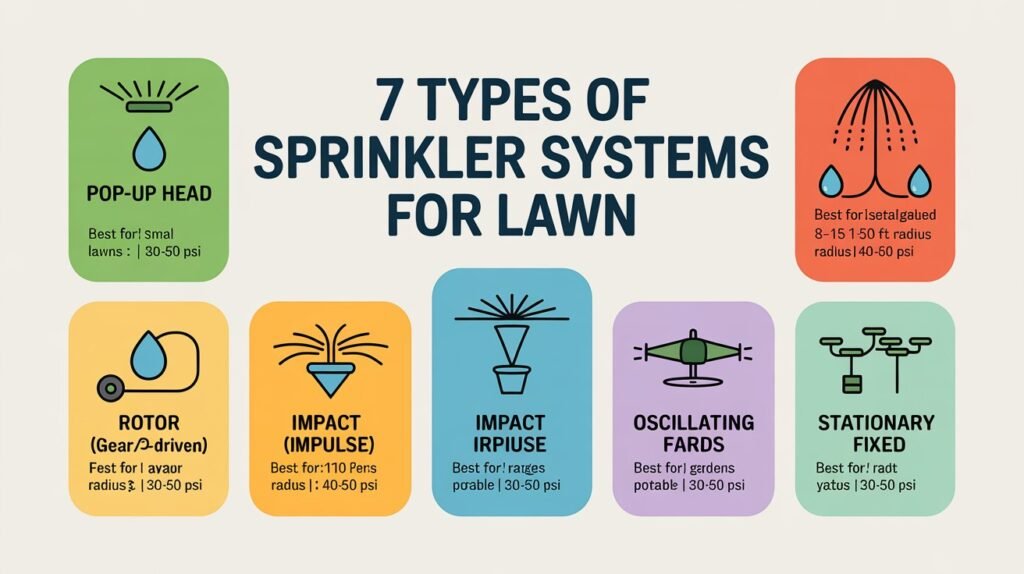
The main types of lawn sprinkler systems include pop-up spray heads (best for small to medium lawns, 8–15 ft radius, 30–40 PSI), rotor sprinklers (best for large lawns, 20–50 ft radius, 40–50 PSI), impact sprinklers (heavy-duty, long-throw), oscillating sprinklers (portable, rectangular coverage), and drip irrigation (most water-efficient, for gardens and beds—not turf).
Below, we break down every type, compare them side-by-side, and give you a clear framework to choose the perfect fit for your property. For more lawn care tips, visit our main website.
Table of Contents
Detailed Breakdown of Each Sprinkler Type
Pop-Up Spray Heads
Best for: Small to medium residential lawns, narrow strips, and irregularly shaped yards.
Pop-up spray heads are the most common type found in residential in-ground systems. They sit flush with the ground when off and pop up to about 2–4 inches when water pressure is applied. They deliver a fixed spray pattern—usually a quarter, half, or full circle.
- Coverage Radius: 8 to 15 feet
- Operating Pressure: 30 to 40 PSI (Pounds per Square Inch)
- Precipitation Rate: 1 to 2.5 inches per hour
- Pros: Inexpensive, easy to adjust, hidden when not in use.
- Cons: Higher water output means shorter run times; prone to clogging if debris is in the water; poor performance in windy conditions.
Expert Fact: At the standard rate of 1.5 inches per hour, a pop-up spray head applies ¼ inch of water in just 10 minutes. This is the benchmark timing for turf irrigation scheduling in most North American soils.
Rotor (Gear-Driven) Sprinklers
Best for: Medium to large lawns (over 2,500 sq. ft.) and wide-open spaces.
Rotor sprinklers operate differently than sprays. Instead of a fixed mist, they use a rotating stream of water that slowly turns 360 degrees or a specific arc. Gear-driven rotors are quiet and highly reliable.
- Coverage Radius: 20 to 50 feet
- Operating Pressure: 40 to 50 PSI
- Precipitation Rate: 0.5 to 1.5 inches per hour
- Pros: Much more water-efficient than spray heads; less runoff on slopes; fewer heads needed to cover large areas.
- Cons: More expensive than spray heads; require higher pressure; take longer to apply water.
Impact (Impulse) Sprinklers
Best for: Large areas, hilly terrain, and windy conditions.
You have seen these on farms or large sports fields. They use a spring-loaded arm that “impacts” the water stream, breaking it into droplets. They are noisy but incredibly tough.
- Coverage Radius: 30 to 90 feet
- Operating Pressure: 40 to 60 PSI
- Precipitation Rate: 0.5 to 1 inch per hour
- Pros: Highly durable; large water droplets resist wind drift; excellent for large lawns.
- Cons: Very loud; high pressure requirements; not ideal for small yards.
Oscillating Sprinklers
Best for: Portable watering, rectangular yards, and temporary setups.
These are the classic metal or plastic units you attach to the end of a garden hose. They have a series of jets that move back and forth to create a fan-shaped curtain of water.
- Coverage: Variable rectangular patterns (usually up to 30×50 ft)
- Pros: Cheap, portable, covers rectangular areas beautifully.
- Cons: Prone to mechanical wear; water efficiency is lower due to wind drift and evaporation; requires manual moving.
Stationary/Fixed Sprinklers
Best for: Small gardens, spot watering, and children’s play areas.
These sprinklers have a fixed pattern (spray, fan, or ring) and do not move. They are usually made of plastic or metal and sit on a stake you push into the ground.
- Coverage: 10 to 20 feet
- Pros: Extremely cheap, simple, durable.
- Cons: Not adjustable; can cause overwatering in specific spots.
Traveling Sprinklers
Best for: Very large, flat, irregularly shaped lawns.
A traveling sprinkler uses water pressure to drive a small tractor that pulls itself across your lawn, following the path of the hose. It shuts off automatically when it reaches the end.
- Coverage: Up to 200 feet (or until the hose runs out)
- Pros: Covers huge areas with one setup; automatic shut-off saves water.
- Cons: Requires flat terrain; hose tangling issues; slow.
Drip Irrigation
Best for: Flower beds, vegetable gardens, shrubs, and trees—not for turf grass.
Drip irrigation delivers water directly to the root zone of plants through a network of tubes, emitters, and valves.
- Operating Pressure: 15 to 30 PSI (requires a pressure regulator)
- Efficiency: Up to 90%+ (compared to 50-70% for overhead sprinklers).
- Pros: Highly water-efficient; reduces fungal diseases (no wet leaves); precise watering.
- Cons: Does not cover large turf areas; more complex to install; tubing can be damaged by rodents or sun.
In-Ground vs. Hose-End Sprinkler Systems
A crucial distinction searchers often miss is the difference between in-ground (permanent) and hose-end (portable) systems.
| Feature | In-Ground Systems | Hose-End/Portable Systems |
|---|---|---|
| Convenience | Automated—set it and forget it. | Manual—you must move it every 20-30 minutes. |
| Aesthetics | Heads retract below ground. | Visible equipment on the lawn. |
| Water Coverage | Highly uniform with proper design. | Often overlaps or misses spots. |
| Cost | High upfront ($500 – $5,000+). | Low upfront ($20 – $200). |
| Maintenance | Requires winterization and zone checks. | Easy to replace or store indoors. |
Actionable Advice: If your yard is over 3,000 sq. ft. and you value your time, an in-ground system is worth the investment. If you have a small postage-stamp yard or rent your home, a high-quality oscillating or impact hose-end sprinkler will serve you just fine.
[Commercial Bridge]: Considering an in-ground upgrade? Choosing the right heads is just the first step. A professional design ensures you avoid dry spots and wasted water. Explore our top-rated rotor and spray head bundles on our products page. Learn more about our installation services.
How to Choose the Right Sprinkler System for Your Lawn
To avoid buyer’s remorse, run your situation through this 4-step decision framework:
Step 1: Measure Your Lawn Size
- Under 2,500 sq. ft: Pop-up spray heads or oscillating sprinklers are your best bet.
- 2,500 to 5,000 sq. ft: Gear-driven rotors are ideal.
- Over 5,000 sq. ft: Impact sprinklers or a professional-grade rotor system.
Step 2: Check Your Water Pressure
- Under 30 PSI: Drip irrigation only. Sprays will not work properly.
- 30 – 40 PSI: Pop-up spray heads are perfect.
- 40 – 50 PSI: Rotors and impact sprinklers will perform at peak efficiency.
- Over 60 PSI: You must install a pressure regulator. High pressure causes misting and atomization, wasting up to 30% of water to the wind.
Expert Fact: To check your pressure, buy a simple pressure gauge (under $15) from a hardware store and attach it to your outdoor spigot. Run the water and read the gauge—this number dictates your entire system choice.
Step 3: Evaluate Your Lawn Shape
- Square/Rectangular: Oscillating sprinklers or rotor heads with matched precipitation rates.
- Irregular/Narrow: Pop-up spray heads with adjustable pattern nozzles (e.g., 90°, 180°, 360°).
- Sloped: Use rotors or drip irrigation. Slopes require low precipitation rates to prevent runoff (under 1 inch per hour).
Step 4: Budget
- $30 – $100: Go with an oscillating or traveling sprinkler.
- $300 – $800: DIY an in-ground system with a few zones of pop-ups and rotors.
- $2,000+: Hire a professional for a custom 6-8 zone system with smart Wi-Fi controllers.
Sprinkler System Comparison Table [INFO-GAIN ASSET]
Bookmark this table—it is the only reference you need to compare every sprinkler type at a glance.
| Sprinkler Type | Best Lawn Size | Coverage Radius | PSI Range | Precip. Rate (in/hr) | Relative Cost | Best Use Case |
|---|---|---|---|---|---|---|
| Pop-Up Spray | Small–Medium | 8–15 ft | 30–40 | 1.0 – 2.5 | $ | Narrow strips, small lawns |
| Gear-Driven Rotor | Medium–Large | 20–50 ft | 40–50 | 0.5 – 1.5 | $$ | Large, open turf areas |
| Impact (Impulse) | Large | 30–90 ft | 40–60 | 0.5 – 1.0 | $$ | Windy areas, large fields |
| Oscillating | Small–Medium | Varies (Rectangular) | 30–60 | Varies | $ | Rectangular portable watering |
| Stationary/Fixed | Small | 10–20 ft | 30–50 | High | $ | Small garden beds |
| Traveling | Extra-Large | Up to 200 ft | 40–60 | Low | $$$ | Flat, large lawns |
| Drip Irrigation | N/A (Gardens) | N/A | 15–30 | Very Low | $$ | Flower beds, trees, shrubs |
Sources: Industry standard specifications (Rainbird, Hunter, Colorado State Extension).
Common Sprinkler System Mistakes to Avoid
Even with the best intentions, homeowners often make these costly errors:
- Mixing Head Types on the Same Zone: Never mix rotors and spray heads on the same valve. They have different precipitation rates. Sprays put out water 3x faster than rotors. If mixed, your lawn will flood near the sprays while the rotors remain thirsty.
- Assuming All Heads Have the Same Radius: Nozzles dictate radius. You must install the correct nozzle for the distance needed.
- Overlapping Incorrectly: In the irrigation industry, we follow the “Head-to-Head” coverage rule. Each sprinkler head should be spaced so that water sprays to the adjacent head. This ensures 100% coverage.
- Ignoring Winterization: If you live in a freeze zone and leave water in the pipes, they will crack. You must blow out the system with compressed air before winter.
DIY vs. Professional Installation
When to DIY
- You have a small yard (under 2,500 sq. ft).
- You are comfortable digging trench lines and gluing PVC pipes.
- Your local water pressure is stable (40-50 PSI).
- You plan to use simple pop-up spray heads.
When to Call a Professional
- Your yard has slopes exceeding 8 vertical feet.
- Your water pressure exceeds 60 PSI or is below 25 PSI.
- You are designing a system with more than 4 zones.
- You want a smart controller integrated with rain sensors.
[TRUST SIGNAL]: There is no shame in calling a professional. An incorrectly designed system can waste 15,000+ gallons of water a year and kill your grass. It is far cheaper to pay for a design than to pay water bills for a broken system.
Not sure where to start? Grab our free “Sprinkler System Sizing Cheat Sheet” to calculate exactly how many heads you need in under 5 minutes. Download now.
Frequently Asked Questions
Q: What is the most water-efficient sprinkler system for lawns?
A: For turf, gear-driven rotors are the most efficient because they deliver water at a slower rate (under 1 inch per hour), which allows the soil to absorb the water rather than losing it to runoff. For gardens, drip irrigation is the absolute gold standard at 90%+ efficiency.
Q: How many sprinkler heads can I put on one zone?
A: A general rule of thumb is to add up the flow rates (GPM) of all your heads and ensure the total is less than the GPM capacity of your water supply and valve. Most residential valves handle 10-15 GPM. For sprays, you might get 8-10 heads; for rotors, usually 4-6 heads.
Q: Can I mix rotor and spray sprinklers in the same system?
A: Yes, but only if they are on different zones (valves) . Mixing them on the same valve causes severe over-watering in the spray areas because sprays put down water 3x faster than rotors.
Q: What PSI do I need for a lawn sprinkler system?
A: 30-40 PSI for spray heads; 40-50 PSI for gear-driven rotors; 40-60 PSI for impact sprinklers. Always install a pressure gauge at your water source to verify.
Q: Are oscillating sprinklers good for lawns?
A: Yes, but only for small, rectangular, flat lawns. They are inefficient for large areas because they waste significant water to evaporation and wind, especially on hot afternoons.
Final Takeaway
The “best” sprinkler system depends entirely on your lawn’s dimensions, water pressure, and your daily schedule. For small yards, pop-ups or a portable oscillating sprinkler win. For large expanses, invest in rotors or an impact head. For garden beds, drip irrigation is non-negotiable.
Take five minutes today to measure your yard and test your water pressure. Once you have those two numbers, the decision becomes simple.
Additional Resources
- Internal Links:
- External References (High Authority):
- Colorado State University Extension – Methods to Schedule Home Lawn Irrigation
- Iowa State University Extension – Using Sprinklers in the Landscape and Garden
- EPA WaterSense – Efficient Irrigation Technologies
- PNNL – Sprinkler Irrigation Guide
- ASABE/ICC 802-2014 Landscape Irrigation Sprinkler and Emitter Standard